
What Are the Processes and Stages of Body Swelling?

Body swelling refers to the condition where fluid inside the capillaries leaks out into the spaces between tissues, accumulating there. This phenomenon involves various processes and stages, including fluid redistribution due to gravity, dysfunction of specific organs, and sodium retention. Notably, the shifting of swollen areas throughout the day can be explained by fluid movement related to changes in posture. Multiple factors may act together, such as heart, liver, or kidney diseases, certain medications, or from a Korean herbal medicine perspective, dysfunctions of the lung, spleen, or kidney. It is essential to consider both the amount and distribution of fluid, as the approach varies depending on the cause. This article sequentially explores the mechanisms behind swelling, criteria for distinguishing types, and practical points to check in daily life.
Definition: What Is Edema?
Edema is the accumulation of fluid that has escaped from capillaries into the spaces between tissues. It may involve changes in fluid distribution as well as retention of water and sodium. Determining whether it is a temporary change or related to an underlying condition requires examining the timing of onset and accompanying symptoms.
- Day and Evening: When standing or sitting, gravity causes fluid to pool in the calves and ankles, leading to swelling in the legs by evening.
- Night: Lying down can alter the distribution of fluid that accumulated in the lower body during the day. However, this change alone does not allow assessment of kidney function or salt excretion.
- Morning: Swelling around the eyes or face may be noticeable but should not be simply attributed to water not excreted in urine. The frequency and presence of other symptoms should be evaluated.
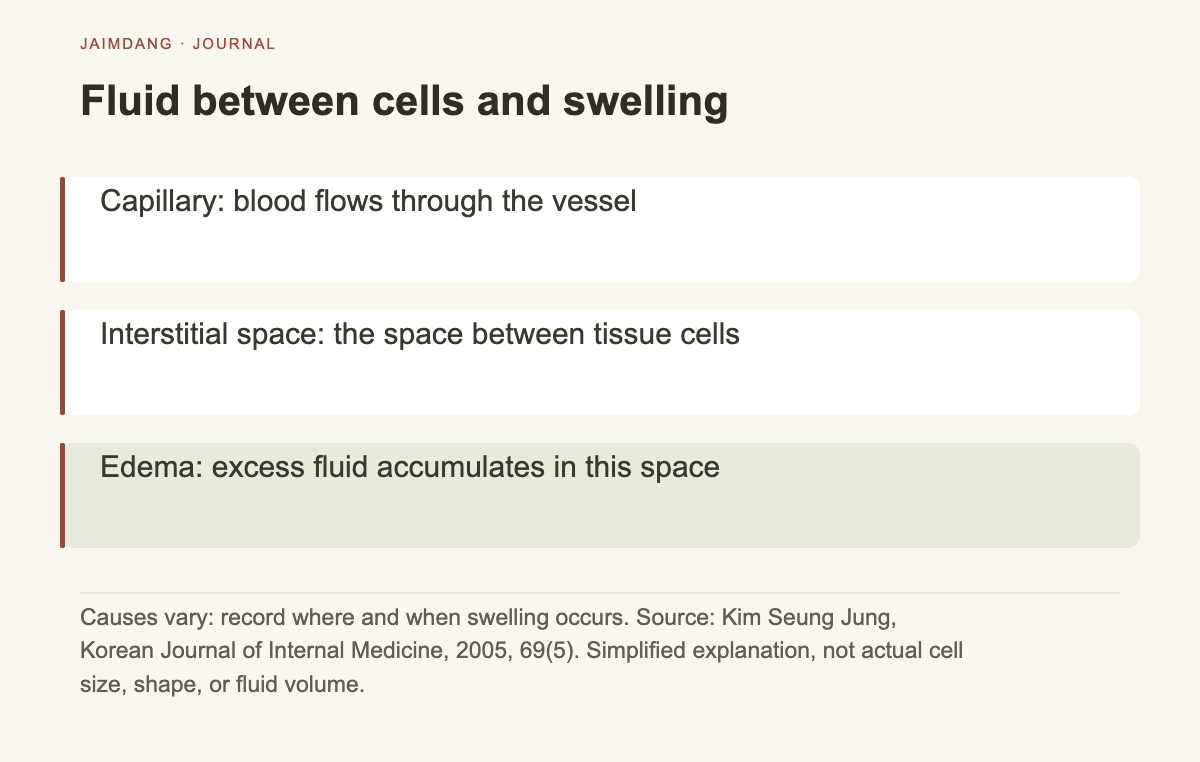
*This simplified conceptual diagram is based on the original definition. It does not represent actual tissue size, shape, or fluid volume.*
Measurements and Criteria: What Should We Look For?
One way to check for edema is to press with a finger on the front bone of the calf for a few seconds.
- Indentation: If the pressed area forms a dent that slowly returns to normal, it is classified as pitting edema; if it does not indent easily, it is non-pitting edema.
- Sodium Intake: According to the Korea Disease Control and Prevention Agency, the average daily sodium intake of Koreans in 2022 was 3,030 mg, about 1.5 times the target intake of 2,000 mg. The highest consumption was observed among people in their 30s and 40s.
- Salt and Water: Adjusting salt intake may help depending on the cause. Solutions do not involve indiscriminately reducing water intake or arbitrarily using diuretics. If there are existing guidelines for fluid intake due to underlying conditions, those should be followed.
Comparison: How Do Types of Swelling Differ?
Edema can be classified based on the response to pressure and underlying causes. Systemic edema also shows characteristic patterns related to dysfunction of specific organs. Certain medications may also cause swelling.
| Type | Pitting Edema | Non-Pitting Edema |
|---|---|---|
| Response to Pressure | Indents and slowly returns | Does not indent easily |
| Possible Causes | Fluid redistribution, heart/liver/kidney diseases, medications | Lymphedema, myxedema (hypothyroidism) |
| Response to Diuretics | Varies by cause | Usually poor response |
| Cause | Characteristic Features |
|---|---|
| Heart Failure | Right-sided failure causes peripheral edema; left-sided mainly pulmonary edema |
| Cirrhosis | Ascites and leg edema; central venous pressure normal or low |
| Nephrotic Syndrome | Periorbital edema, heavy proteinuria, hypoalbuminemia; confirmed by tests |
- Medication Timing: Common drugs that may cause edema include painkillers, contraceptives, antihypertensives, and steroids.
- Menstrual Cycle: Pre-menstrual swelling is sometimes explained by estrogen-induced water and salt retention.
Procedure: What Are the Steps to Assess Swelling?
When evaluating swelling, consider the following steps:
- Check for sudden changes. If one leg swells suddenly, or if there is shortness of breath or rapid weight gain over a few days, seek medical attention immediately. These symptoms may indicate serious conditions such as deep vein thrombosis or pulmonary edema.
- Note medication start dates. Remember when any new medications were started. Inform healthcare providers about all current medications when investigating causes.
- Review lifestyle factors. If no underlying disease is present, consider lifestyle management such as controlling sodium intake.
In Korean herbal medicine, edema is sometimes explained as a disruption of qi transformation caused by dysfunction of the lung, spleen, and kidney organs. This perspective is distinct from the fluid redistribution explanation above.
For information on related products, please refer to the Gongbihwan Guide.
FAQ
Does drinking a lot of water cause more swelling?
It is difficult to attribute swelling solely to the amount of water consumed. Edema relates to where fluid accumulates and often involves sodium retention, so salt intake is also considered. Fluid redistribution due to posture can influence swelling, but if swelling recurs or worsens, other causes should be investigated.
When should I go to the hospital immediately for swelling?
If one leg swells suddenly, if you experience shortness of breath, or if your weight increases rapidly over a few days, seek medical care promptly. Unilateral leg swelling is a critical sign that deep vein thrombosis must be considered, with pulmonary embolism being the most serious complication. Do not delay seeking medical help by relying solely on lifestyle management for such sudden changes.
Reference Original Text
jaimdang Korean Herbal Care
Online consultation and prescriptions tailored to your constitution.
View products