
Holding Your Breath During Strength Training: Yangsaeng and Keeping a Breathing Log
If you are holding your breath to complete repetitions during strength training, it is time to reconsider today’s load and movements. The phrase ‘xing lao er bu juan (形勞而不倦, activity without exhaustion)’ found in the yangsaeng, traditional life-nurturing care literature of Korean medicine encourages reflection on both activity and fatigue together; it is not a technique for prolonged breath-holding nor a formula prescribing fixed weights. This article takes that traditional perspective as a starting point for breathing records and explains specific exercise safety guidance separately using modern materials.
Contents
What does “activity without exhaustion” mean?
In the “Shanggu Tianzhen Lun” chapter of the 《Huangdi Neijing·Suwen》, the phrase ‘形勞而不倦’ appears. It can be read as moving the body without becoming fatigued, and the same chapter also addresses moderation in eating and drinking as well as daily living habits. What is drawn from this text is a perspective that considers activity in the context of the whole lifestyle. Original Chinese text of “Shanggu Tianzhen Lun”
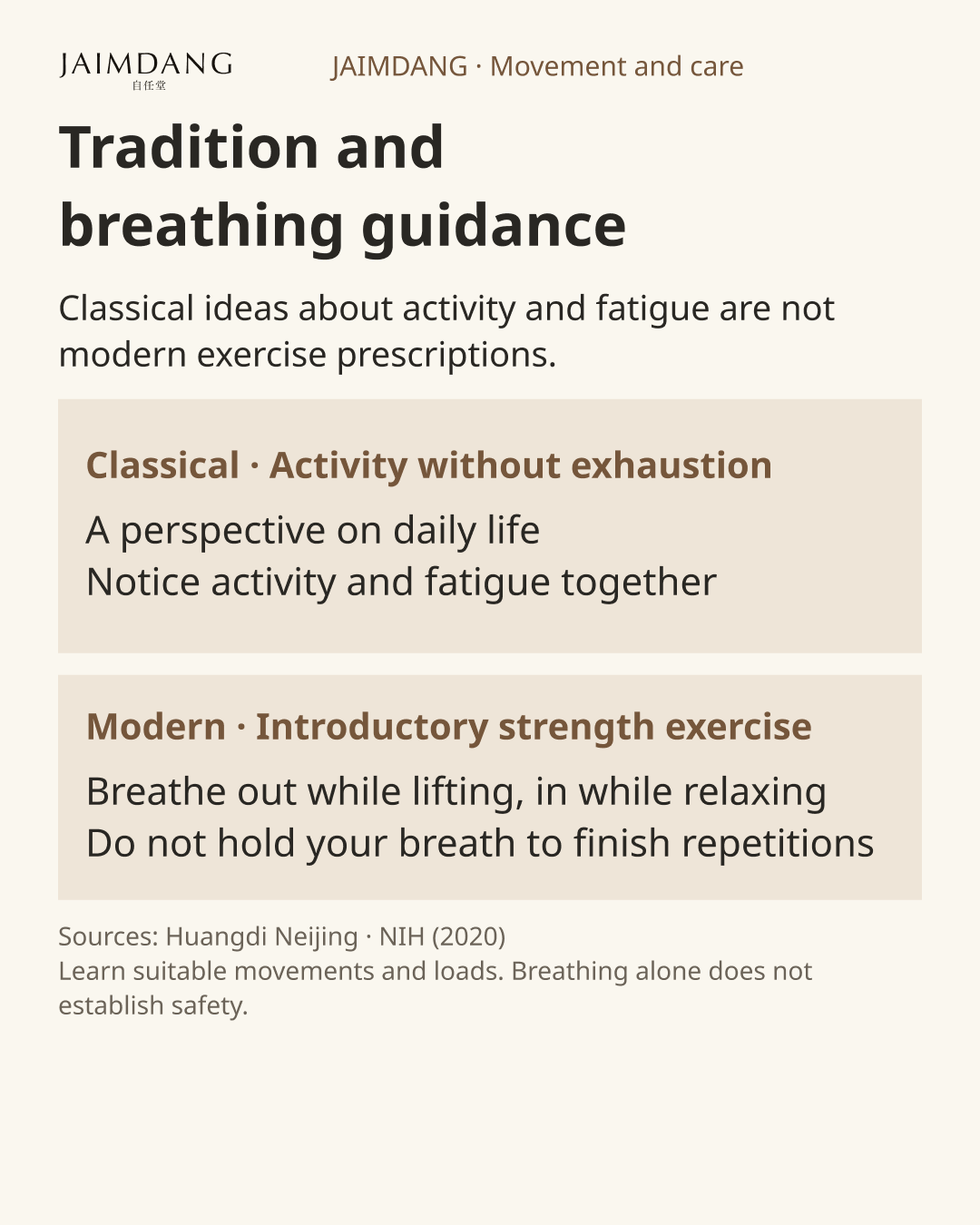
Classical texts do not prescribe how many kilograms to lift or how many seconds to hold your breath in modern dumbbell exercises. That phrase is not converted into clinical evidence for safe blood pressure or muscle growth. Expressions like “cultivating qi” are not translated into instructions to increase oxygen intake or hold breath longer, as that would exceed the scope of these materials.
How Do We Differentiate Between Exercise Repetitions and Breathing Records?
The NIH’s 2020 guidance on strength training recommends that adults engage in activities that strengthen major muscle groups on two or more days per week. This number refers to the frequency of activity within a week and does not prescribe holding one’s breath for a certain number of seconds or performing a specific number of repetitions per movement. The same guidance advises starting slowly with light weights and proper form, emphasizing not to hold your breath while exerting force. NIH Original Source
The planned number of exercise days and instances where breathing is interrupted during actual movements should be recorded in separate sections. Even if the scheduled days are completed, any breakdown in posture or discomfort should not be omitted. Conversely, simply noting a pause to learn a movement does not mean the entire activity was ineffective. The key is not to convert the general frequency recommendation into a personalized prescription of weight, repetitions, or breath-holding duration.
How Do We Compare Today’s Exercise Conditions?
The table below is not an exercise method that literally implements the traditional phrase but an observational note suggested by the editorial team. It adds a column to records that previously only noted repetitions, to explain “where the strain occurred.”
| Scene to Reflect On | Question from the yangsaeng, traditional life-nurturing care Perspective | To Check Separately in Modern Exercise Guidance |
|---|---|---|
| Holding breath to reach target repetitions | Was there an overemphasis on hitting the number? | The phase of exertion in the learned movement and breathing |
| Starting new weight and new movement together | Can you explain today’s changed load? | Posture and load adjustment and instructor confirmation |
| Days with insufficient sleep or discomfort | Did you consider life outside exercise as well? | Activity range appropriate for symptoms and conditions |
Here, the cause of discomfort is not conclusively attributed to constitution or qi deficiency. Lifestyle notes serve as materials for consultation and guidance, and records of continuous breathing do not guarantee safety. The following breathing explanation is not evidence proving the classical effect but general modern exercise beginner guidance.
Should you hold your breath continuously when exerting force?
The NIH’s general strength training guidance explains that holding breath can alter blood pressure, so do not hold your breath; exhale when lifting weight and inhale when releasing force. This is general beginner guidance and does not imply professional competitive techniques applicable to all sports and situations. NIH, Maintain Your Muscle
Do not imitate methods seen in short videos of others lifting heavy equipment. It is better to confirm with your instructor which phase of the movement requires exertion and what posture to maintain. Changing breathing alone does not resolve incorrect posture or excessive load.
What Is the Procedure for Observing Movements and Breathing Together?
First, select movements and tools you have already learned. Applying new movements, heavier weights, more repetitions, and new breathing instructions all at once makes it difficult to distinguish which change caused difficulty. Next, verbally explain the preparation phase and exertion phase of the movement. If it is difficult to explain, relearning the movement is more important than increasing repetitions.
For example, if practicing a lifting movement learned with light equipment, observe whether you exhale during lifting and whether breathing naturally continues during the return phase. Do not set goals to hold breath for seconds or push through to a fixed number while breathless. Specific movements should be guided according to your current physical condition.
What additional columns are useful in exercise records?
| Originally Recorded Item | Additional Content to Record | Questions to Check Next Time |
|---|---|---|
| Movement name | Where breathing was interrupted | Did you understand the movement sequence? |
| Equipment and weight | Was it difficult to maintain posture? | Is load adjustment necessary? |
| Number of repetitions | When and why you stopped midway | Did you overexert to reach the number? |
| Feeling after exercise | Presence of pain, dizziness, or discomfort | Is medical or instructor confirmation needed? |
This table is for recording your experience. It is not a test to judge normal blood pressure or safety. The fact that breathing was interrupted alone does not diagnose lung function, physical fitness, or a traditional Korean medicine pattern of qi deficiency. It is also important not to use traditional terms related to yangsaeng, traditional life-nurturing care, or breathing as equivalents to modern blood pressure values or exercise prescriptions.
Distinguish between breathlessness and discomfort requiring assistance
Breathing may vary with exercise intensity, but chest pain, fainting, or severe dyspnea should not be interpreted as exercise benefits. Stop exercising and seek immediate medical help. If you have chronic diseases or joint problems and want to change activity levels, confirm appropriate ranges with healthcare professionals. NIDDK’s Guide to Starting Activity
Even without discomfort, if it remains difficult to coordinate movement and breathing, do not just increase weight but seek guidance. Rather than recording stopped repetitions as failures, noting under what conditions difficulty occurred makes it easier to discuss the next plan.
Monitoring exercise records and the use of medications are distinct matters. Jaimdang Product Information provides details on product purposes and guidance; however, the breathing explanations in this text do not serve as evidence of any specific product’s exercise benefits.
Frequently Asked Questions
Does better breathing make weight loss faster?
This guidance is not a breathing method to accelerate weight loss. Breathing, strength training performance, and weight change are not the same outcome indicators.
If I reduce repetitions, does that mean the exercise was ineffective?
Effectiveness is not judged by a single number. How to adjust movements and load can be found in Starting and Progressing Strength Training. This article separately addresses situations where breathing is overlooked.
Can the talk test for walking be used as is?
The talk test for walking intensity is in the context of assessing aerobic activity intensity. It is not converted into a test for appropriate weight in strength movements or individual medical safety.
jaimdang Korean Herbal Care
Online consultation and prescriptions tailored to your constitution.
View products