
Are All Fermented Foods Probiotics? A Food-Care Perspective
Fermented foods discussed in sikchi, traditional Korean food-based care, are not automatically probiotics. It is important to distinguish between examining what ingredients are eaten and how in a meal, and verifying under what conditions specific strains may be beneficial to health. The names kimchi, doenjang, and yogurt alone cannot predict gut microbiota status or changes in body weight. Today at the table, check in order whether the food is fermented, whether live microorganisms are indicated, and the overall composition of the food.
Contents

How Do Sikchi’s Food Classifications Differ from the Definition of Probiotics?
The Korean Institute of Oriental Medicine provides the translated 《Sikmulboncho (食物本草, Food Materia Medica)》, which discusses fermented soybeans (douchi, 豆豉) among seasonings and notes that preparation methods vary by region. It also distinguishes several categories of dairy foods. The perspective to note here is that ingredients with similar names may differ in preparation methods and actual appearance. The efficacy or non-toxicity expressions recorded in classical texts are not transferred as safety or weight-loss effects for all fermented foods sold today.
Applying these distinctions to the modern table means that rather than “fermentation is good, so eat a lot,” the first question is “what ingredients and preparation methods does the food I am eating involve?” A soup with doenjang, a side dish eaten without heating, and bread baked after fermentation cannot be evaluated as the same category. The explanations of sikchi in Korean medicine and modern microbiological research are based on different evidence, and traditional property classifications are not explained by strain names or counts of live microbes.
The U.S. National Institutes of Health Office of Dietary Supplements defines probiotics as live microorganisms that, when consumed in adequate amounts, confer a health benefit. The mere fact that microorganisms were used in the fermentation process does not mean the food contains probiotics with confirmed effects. Conversely, probiotics may be added separately to non-fermented foods. Manufacturing processes, the state at the time of consumption, and confirmed effects are distinct questions.
How Should the Numbers of Microbes on Packaging Be Interpreted?
Examples from NIH materials show labels such as 1×10⁹ CFU and 1×10¹⁰ CFU, meaning 1 billion and 10 billion respectively. CFU is a unit used to express the number of live microorganisms, but a tenfold increase in number does not mean tenfold health benefits. These figures are examples of reading product labels, not recommended dosages.
Next to the numbers, check which strain it is, what the count is based on, and until when the count is valid. The quantity at manufacturing and the quantity maintained until the expiration date may not be the same information. Also verify the storage conditions specified by the product. If the labeling is unclear, do not fill in values arbitrarily; keep it as a question to ask the manufacturer. Comparison tables that only list “how many billions” may miss the fact that the products are different.
Distinguish between large text on the front of the package and the actual amount consumed at one time. First, see whether the description applies to the entire bottle or the indicated serving size. For a food shared with others, record your portion separately from the amount in the whole container. Even if the exact numbers are unknown, having product photos and records of actual consumption methods makes it easier to explain during consultation. There is no need to eat more than usual just to fill out records accurately.
How Do Fermented Foods, Live Microbes, and Probiotics Compare?
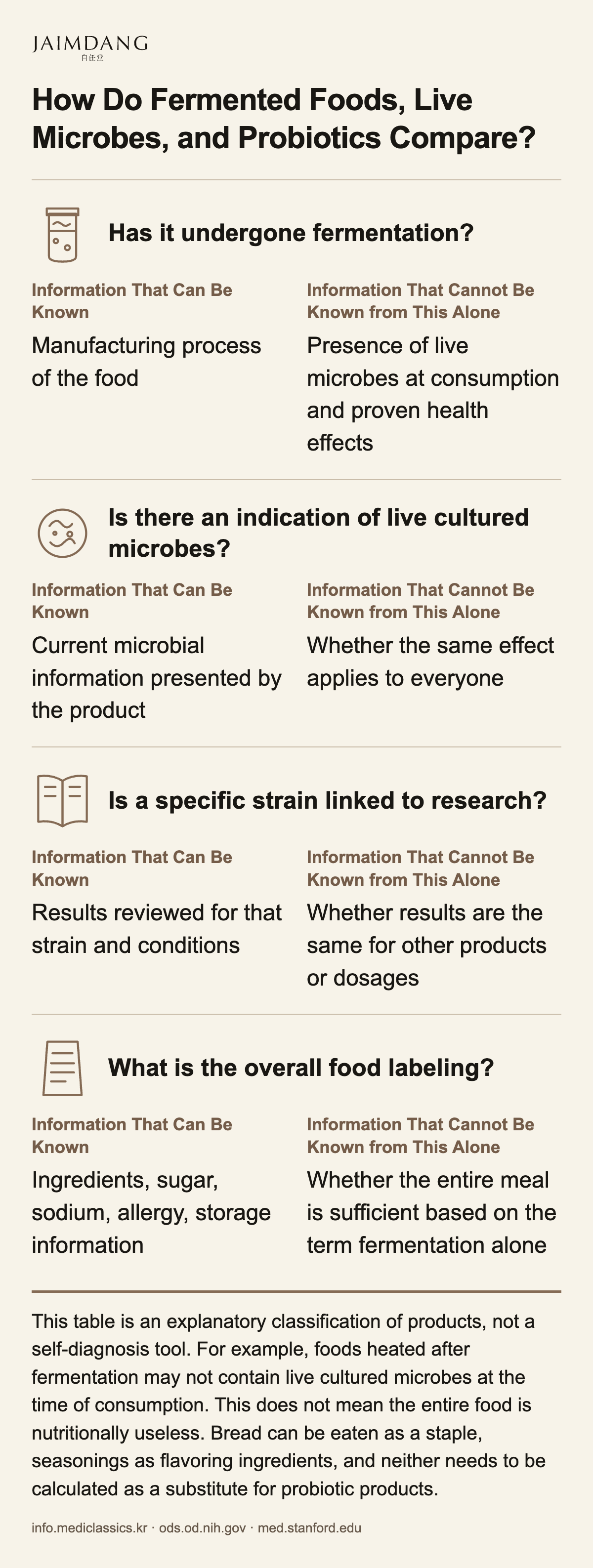
| Question to Confirm | Information That Can Be Known | Information That Cannot Be Known from This Alone |
|---|---|---|
| Has it undergone fermentation? | Manufacturing process of the food | Presence of live microbes at consumption and proven health effects |
| Is there an indication of live cultured microbes? | Current microbial information presented by the product | Whether the same effect applies to everyone |
| Is a specific strain linked to research? | Results reviewed for that strain and conditions | Whether results are the same for other products or dosages |
| What is the overall food labeling? | Ingredients, sugar, sodium, allergy, storage information | Whether the entire meal is sufficient based on the term fermentation alone |
This table is an explanatory classification of products, not a self-diagnosis tool. For example, foods heated after fermentation may not contain live cultured microbes at the time of consumption. This does not mean the entire food is nutritionally useless. Bread can be eaten as a staple, seasonings as flavoring ingredients, and neither needs to be calculated as a substitute for probiotic products.
Stanford Nutrition research also distinguishes whether heat treatment was applied after fermentation and whether microbes were added afterward. However, the mere fact that a product is refrigerated in a store does not certify specific effects. Terms like “raw,” “natural,” and “traditional” do not replace microbial testing or clinical research of the product. Hygiene and storage checks should not be omitted simply because the food is homemade.
What Are the Steps to Connect Sikchi’s Perspective to Today’s Grocery Shopping?
First, note the role the food to be purchased will play in a meal. Whether yogurt is eaten as a snack, doenjang added to soup, or a fermented beverage replaces a meal changes what to check. Also check whether adding a specific fermented food causes the omission of staple, protein, or vegetable foods. This is a perspective of viewing the entire meal rather than just the name of one food.
Second, check the raw materials and processing/storage labels. Apart from the word fermentation, read whether heat treatment, added ingredients, and post-opening storage instructions are present. Do not assume a newly purchased product is the same as a previous one; check what has changed. If storage space or transport time does not meet the label conditions, decide on different purchasing or storage methods. Do not change product safety guidelines just to preserve more microbes.
Third, set comparison criteria. When comparing two yogurts, look at nutrition labels based on the same quantity. When comparing fermented side dishes and supplements, first note the difference between food and supplement. Avoid ranking different categories of items by a single microbe count. For products requiring sugar or sodium labeling, read that information as well and do not exclude them just because they are fermented.
Fourth, record any discomfort after eating but do not jump to conclusions about causes. Write down the new product, amount eaten, foods eaten together, and timing of discomfort. Do not interpret gas after eating fermented foods as an immediate sign of gut improvement, nor confirm a specific strain’s effect based on one comfortable experience. Do not deliberately eat the same product again or change prescribed medication just to check discomfort. For persistent symptoms, consultations focus on symptom patterns rather than food names.
Frequently Asked Questions
Can I Choose Only One Between Traditional Fermented Foods and Probiotic Supplements?
Because their roles and evidence differ, they cannot be viewed as interchangeable. First organize your usual meal composition and reasons for using products. If considering products for therapeutic purposes, verify evidence for the specific product, strain, and purpose with healthcare professionals.
Does Choosing the Product with the Highest Microbe Count Help More with Weight Management?
You cannot judge that way. Microbe count is one item of product information, not a ranking for weight loss. Look at actual meal, beverage, and snack composition together, and do not change meals based on unconfirmed promises.
Can Family Members with Weak Health Eat the Same Product?
People with severe illnesses or compromised immune function need separate risk assessment for probiotics. Do not start together just because family members are eating it; inform healthcare providers of product names and intended use. Distinguish between storage and allergy information for general foods and usage decisions for supplements.
Reference Original Text
- Korean Institute of Oriental Medicine, Translated Sikmulboncho (食物本草, Food Materia Medica): PDF page 217 on fermented soybeans (douchi, 豆豉) and page 231 on dairy food categories. Confirmed traditional classifications and did not use as evidence for modern efficacy.
- NIH ODS, Probiotics: Definitions, CFU label examples, strain, storage, and health status considerations.
- Stanford Nutrition, How to Recognize Fermented Foods: Explanation distinguishing fermentation, heat treatment, and microbial addition.
Further Reading
You can check an entire meal in Meal Composition and Lifestyle Records. Jaimdang Product Information is a separate route to verify actual product information; this article does not prove probiotic effects of any specific product.
jaimdang Korean Herbal Care
Online consultation and prescriptions tailored to your constitution.
View products