
Seaweed, Kelp Supplements and Iodine: What Should You Record?
The appearance of seaweed in traditional Korean food-care (sikchi) literature does not mean that you can consume more kelp supplements. You need to separately verify the product form and intake amount of seaweed eaten as side dishes or in soups and supplements labeled with iodine. Especially if you have thyroid disease or are undergoing related treatment, do not convert traditional literature descriptions into self-medication guidelines; instead, provide actual information on foods, supplements, and medications together.
Contents
How do the descriptions of seaweed in Sikchi and the definition of iodine differ?
The Korean translation of 《Sikmulboncho (食物本草, Food Materia Medica)》 includes entries describing zao (藻, algae) and haizao (海藻, seaweed) among vegetables. It presents traditional properties and disease symptom expressions alongside methods of consumption as food. This record shows how past Sikchi literature treated seaweed, but the disease names in classical texts cannot be equated with today’s thyroid diagnoses nor converted into effects of commercial supplements. Even if names appear similar, it is necessary to verify the exact biological species and product forms.
Iodine is a trace nutrient necessary for producing thyroid hormones. However, the statement that it is “necessary” differs from saying “the more you consume, the better.” The NIH Office of Dietary Supplements explains that excessive iodine intake can also cause thyroid dysfunction, and individual responses may vary. Deficiency or excess should not be judged solely by the sensation of eating seaweed or changes in body weight.
The Sikchi question applied here is “which ingredient was added to the meal in what form.” Ingredients used to make broth and then removed, side dishes eaten as is, powdered products, and capsule supplements cannot be combined in the same record category. While examining traditional food classifications, the iodine content of modern products is distinguished based on actual labeling or analytical data. Traditional terms do not fill in blanks on ingredient labels.
Whose standard is the figure 150μg?
The adult iodine recommended intake of 150μg per day introduced by NIH materials is the U.S. Food and Nutrition Board’s standard. This is a nutritional intake guideline for the U.S. and does not instruct everyone in every country to add that amount as a supplement. It is a standard considering both food and supplements together. Because it must be judged separately depending on pregnancy, lactation, disease, and treatment situations, it should not be directly applied as an individual supplementation requirement.
Units must also be distinguished. 1mg equals 1,000μg. The “kelp powder several mg” and “iodine several μg” indicated on packaging represent the total weight of the ingredient and the amount of a specific component, respectively, which are different pieces of information. Do not read powder weight as iodine amount or record zero just because iodine content is not indicated. When converting units, specify what quantity is being measured.
Iodine content in seaweed can vary greatly depending on species and product. One value found on an internet table cannot be applied to all gim (laver), miyeok (wakame), or dasima (kelp) products. Standards for dried and cooked states may also differ, so precise content is not calculated by piece count or handfuls. For foods without labeling, record the name, form, and method of consumption, and classify actual content as unconfirmed.
How to compare ingredients, processed foods, and supplements?
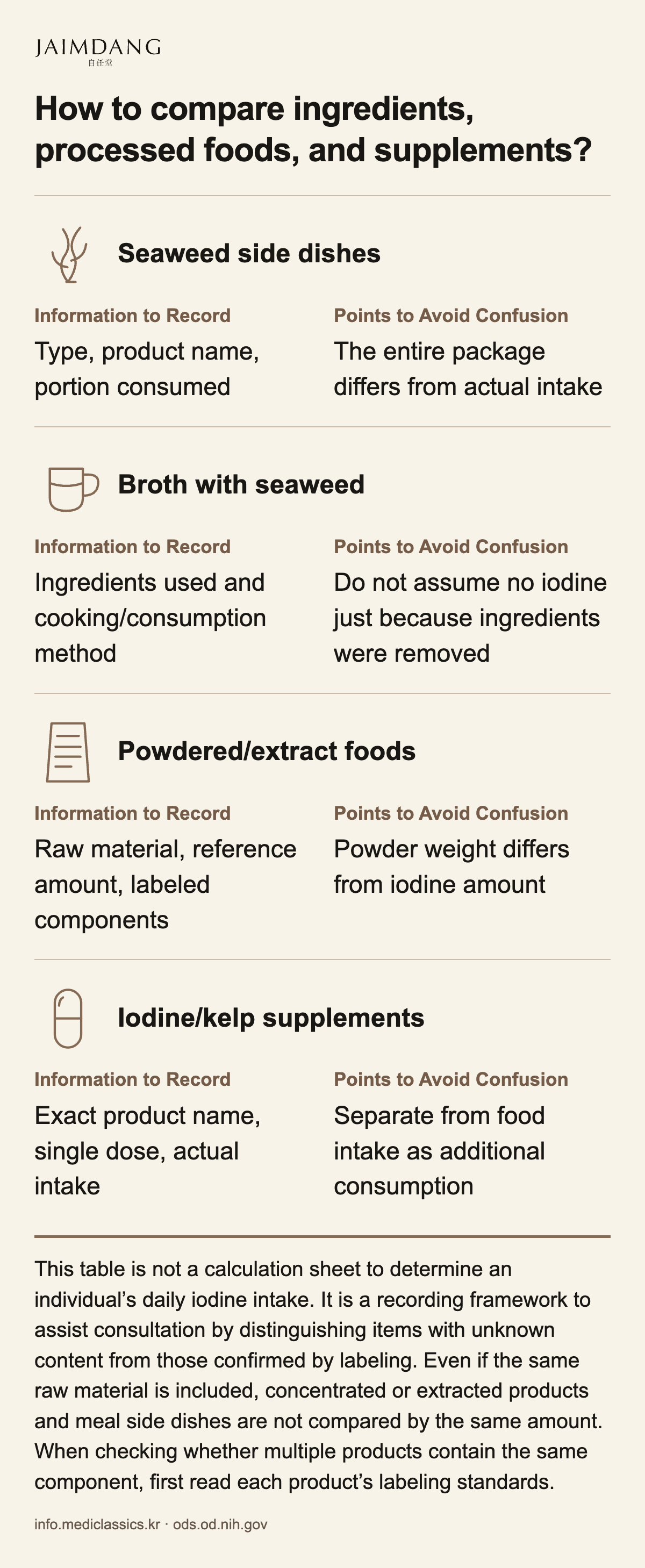
| Subject to Record | Information to Record | Points to Avoid Confusion |
|---|---|---|
| Seaweed side dishes | Type, product name, portion consumed | The entire package differs from actual intake |
| Broth with seaweed | Ingredients used and cooking/consumption method | Do not assume no iodine just because ingredients were removed |
| Powdered/extract foods | Raw material, reference amount, labeled components | Powder weight differs from iodine amount |
| Iodine/kelp supplements | Exact product name, single dose, actual intake | Separate from food intake as additional consumption |
This table is not a calculation sheet to determine an individual’s daily iodine intake. It is a recording framework to assist consultation by distinguishing items with unknown content from those confirmed by labeling. Even if the same raw material is included, concentrated or extracted products and meal side dishes are not compared by the same amount. When checking whether multiple products contain the same component, first read each product’s labeling standards.
For example, if seaweed side dishes are eaten in the morning and kelp supplements taken in the evening, do not combine them as “one seaweed intake” but separate food and supplements. This is a hypothetical situation illustrating recording methods, not an actual patient case or risk calculation. If meals or supplement use vary on other days, note those differences. The goal is not to estimate unknown content to fit numbers.
What is the procedure for organizing dietary records?
First, gather the products currently used and verify their names and labels. Check if there are products expressed differently such as kelp, kelp extract, or seaweed extract. Also verify whether iodine included in multivitamin supplements is separately labeled. If exact content is difficult to read, keep photos of packaging and do not guess content from product names alone. If advertising differs from the actual purchased product label, verify the actual packaging first.
Next, separate records of foods and supplements. For meals, record ingredients and forms consumed; for supplements, record labeled amounts and actual intake. Also note who recommended them and the reason for starting, which helps explain usage purpose. If started based only on phrases like “improves metabolism” or “traditionally used,” do not translate those into proven effects but keep them as questions to verify.
Third, organize medications and treatment situations together. If taking medication for thyroid disease or undergoing tests or treatment, inform the responsible medical staff about food and supplement use. Iodine supplements may interact with some drugs, so product names must be conveyed accurately. Do not arbitrarily increase or decrease prescription drugs or supplements to test reactions. Low-iodine diets for specific treatments differ from general weight management diets, and should not be self-initiated based on online posts.
Fourth, convert unknown parts into questions. Ask specifically, for example, “Does this powder label indicate total ingredient weight or iodine content?”, “Are there overlapping components with the supplements currently taken?”, “Are there special dietary restrictions due to current treatment?” At this time, you can also request explanations distinguishing how classical property descriptions differ from current test results. It is important not to merge explanations at different levels into a single diagnosis.
Finally, organize confirmed guidelines into ways to implement them at the dining table. Separate family-shared foods and individual supplements, and accurately convey only necessary restrictions to the cook. Do not expand one person’s therapeutic diet into a family-wide weight loss method. Conversely, do not ignore separate restrictions just because the food is “natural.” Records are not lists to increase anxiety but tools to find necessary information for the next meal and consultation.
Frequently Asked Questions
Does seaweed mentioned in traditional literature mean it is good for the thyroid?
It cannot be concluded that way. Disease symptom expressions in past literature and today’s thyroid diagnoses are not the same standard. Specific products or treatment effects must be separately verified, and seaweed does not replace prescription drugs.
If iodine is needed, can I supplement more during weight management?
The fact that it is a necessary nutrient does not mean additional supplementation or weight loss effects. Existing food and supplement intake and health status must be reviewed together. Iodine deficiency is not diagnosed by weight changes alone.
Is it safer to avoid all seaweed?
This article does not instruct everyone to avoid seaweed. The purpose is to distinguish and verify food types, supplements, and individual disease and treatment conditions. If you already have dietary guidelines, follow them first and consult your medical staff before making changes.
Sources
- Korea Institute of Oriental Medicine, Korean Translation of Sikmulboncho (食物本草, Food Materia Medica): PDF page 82, zao (藻, algae) and haizao (海藻, seaweed) entries. Traditional Sikchi classification records and not evidence for modern thyroid treatment.
- NIH ODS, Iodine: Health Professional Fact Sheet: U.S. nutrition standards, iodine in foods and supplements, excessive intake and drug interactions.
Further Reading
You can distinguish labeled reference amounts and actual intake amounts in How to Record Food and Product Labels. Jaimdang Product Guide is a route to verify actual product information; this article does not confirm iodine content or thyroid effects of specific products.
jaimdang Korean Herbal Care
Online consultation and prescriptions tailored to your constitution.
View products