
How Is Calorie Calculation Done When Serving Size and Package Amount Differ?
The calorie content for consuming an entire package is calculated by aligning the labeled serving size with the actual amount consumed. First, verify whether the nutrition facts refer to a single serving or the entire package. For example, if one serving contains 220 kcal and the package includes two servings, consuming the whole package amounts to 440 kcal. The figures in this article are based on calculation examples from the U.S. FDA and do not represent nutrition information for any specific product.
What Is a Serving Size?
A serving size on nutrition labels serves as the reference for reading the nutritional content. The amount you actually consume may be equal to or different from this reference. In U.S. nutrition labeling, serving sizes reflect typical consumption amounts and do not imply recommended intake. Do not assume products from other countries follow the same format; always check the packaging for the specific reference.
For instance, even if 220 kcal is prominently displayed on the front of the package, this number alone does not confirm the calorie content of the entire package. You must check the serving size and total package weight on the side or back. The package is a unit of packaging, while the serving size is the basis for nutrition labeling; these two do not always represent the same quantity.
What Is the Calculation Order for Numbers?
Following the FDA example, if a food item has 220 kcal per serving and you consume twice that amount, multiply 220 by 2 to get 440 kcal. If you consume half a serving, the arithmetic result is 110 kcal. First determine how many servings you consumed, then multiply by the labeled calories to avoid mixing different reference points.
For products labeled per 100g, multiply the labeled calories by the actual weight consumed divided by 100g. For products labeled by cup or count, also check the corresponding weight. Even if packaging units differ, converting to the same weight basis allows for consistent comparison. However, if you did not weigh the portion, do not record it as an exact measurement; mark it as an estimate.
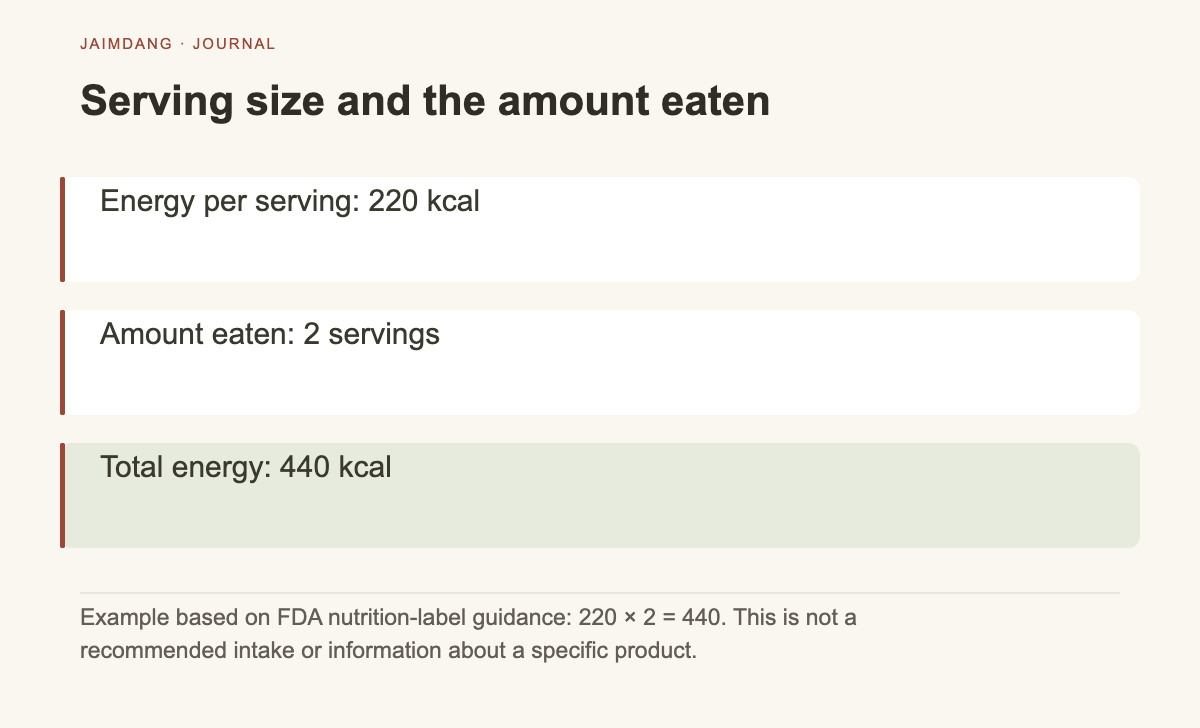
The above diagram explains arithmetic calculations based on the labeled serving size. It is not intended to prescribe individual intake or weight loss goals. This article’s premise is to avoid judging an entire meal’s composition solely because the numbers appear small.
How to Compare a Package and a Serving Size?
| Label Expression | Meaning | Points to Check When Recording |
|---|---|---|
| Per Serving | Nutrition info for the reference serving size | How many servings were actually consumed |
| Per Package | Nutrition info for the entire package | Whether the whole package was consumed or partially left |
| Per 100g | Standardized weight-based comparison | Actual weight consumed |
| Actual Amount Consumed | The amount you chose to eat | Whether it matches the labeled unit |
Some U.S. products display both per serving and per package values side by side. If you have already noted the total calories for the package, do not multiply again by the number of servings. For example, if the total column shows 440 kcal for two servings, multiplying by 2 again would double-count the same amount.
When comparing two products, do not simply place large and small numbers side by side. One product may be labeled per 100g, the other per piece. If the reference units differ, convert both to the same weight or intake amount before comparing. Even if product names are similar, verify that packaging and labeling standards match.
Recommended Recording Procedure
The first step is to check the nutrition information of the product you consumed. Even within the same brand, product and package sizes may vary, affecting the data you record. Record the serving size from the actual package in your hand rather than relying on similar photos found online.
The second step is to record the amount consumed in the same unit. Use clear expressions such as the entire package, half, or a measured weight. If multiple people share the product and the exact amount is unknown, note an approximate amount and mark it as an estimate.
The third step is to record the calculation and result together. For example, write “220 kcal × 2 servings = 440 kcal” to document the reference and multiplier, making it easier to verify later why that number was recorded. If you used the total package value, note “Used per package value” to avoid double counting.
Finally, when correcting records, document the reason for the change. For example, if you initially considered one package as one serving but later confirmed it contains two servings, update the reference accordingly. Do not interpret this as having eaten more or a change in your physical condition. Maintain a clear distinction between record accuracy and meal evaluation.
Frequently Asked Questions (FAQ)
If a product is labeled sugar-free or fat-free, can I ignore calorie counting? The FDA clarifies that such labels do not mean zero calories. Do not skip calculations based solely on these claims; always check the product’s labeled calories and serving size.
Do I have to eat exactly the labeled serving size? No. The serving size on U.S. labels is not a recommended intake. It is important to distinguish between the reference for reading numbers and determining an appropriate personal meal size.
Can I determine weight changes from calorie calculations alone? This calculation confirms intake calories based on the labeled serving size. It does not establish weight changes or weight loss effects over a period. For related records, see the Journal Reflecting on Appetite Situations. The Product Guide provides dosing instructions separate from food serving size calculations and does not apply this formula to medication dosages.
Reference Sources
jaimdang Korean Herbal Care
Online consultation and prescriptions tailored to your constitution.
View products