
Does a bowl of rice porridge provide the same meal as cooked rice?
Rice porridge can be eaten instead of cooked rice, but having the same bowl does not mean it contains the same amount of grains or the same meal composition. When referring to historical Korean food-therapy records about rice porridge when considering meals today, it is necessary to consider what was included and how much was eaten. By distinguishing a preference for soft food from claims about weight loss, one can specifically examine their meal instead of unconditionally avoiding porridge or considering it the answer to every meal.
Contents
How is rice porridge discussed in traditional Korean food therapy?
In the Korea Institute of Oriental Medicine’s Korean translation of 《Shiwu Bencao (Food Materia Medica)》, the jingmi (non-glutinous rice) entry includes content on cooking rice as porridge. Traditional literature described ingredients, cooking methods, and the eater’s situation together. The purpose of introducing this record is not to certify porridge as a modern weight loss diet or a therapeutic diet for specific diseases. Treatment claims or infant feeding methods in the literature are not transferred as recommendations today.
The question to bring into daily life here is “in what form was it eaten?” Even with the same rice, recording whether it was eaten as cooked rice or as porridge with added water clarifies the meal scene. In Korean medicine consultations, this can be used as data to examine appetite, ease of eating, post-meal bloating, and bowel movements together. One experience of porridge being easy to eat does not lead to a diagnosis that the spleen and stomach in traditional Korean medicine are deficient or that it is food suitable for a specific constitution.
Also, consider why you are choosing porridge. Whether it is because breakfast preparation is simple, because it is easy to chew, or because it was guided by medical staff after illness, the points to check next differ. This article is a meal comparison guide for general adults. Situations requiring separate texture and nutritional amounts, such as swallowing disorders, post-surgery meals, or infant weaning foods, should follow their respective guidelines first.
What does the number “one bowl” tell us?
One bowl is a unit of container volume, not a unit of grain quantity. If the same amount of rice and other ingredients were put into the same pot and only water was added, the fact that the volume increased does not mean the original ingredients decreased. Conversely, even if served in the same size bowl, the composition can vary depending on thickness and solids. Calculations dividing the calories of cooked rice by a fixed ratio just because it is called porridge are not done.
The following is an example of distribution calculation, not actual nutritional values of products. If one pot is evenly mixed and divided into four equal portions, one portion can be recorded as about one-quarter of the total ingredients. If solids were concentrated in one bowl or divided into containers of different sizes, this assumption does not hold. The number one-quarter is neither a recommended intake amount nor an exchange ratio between cooked rice and porridge.
Check whether commercial porridge is based on the entire package or per 100g. To compare numbers of two products, standardize the reference amount and separately record the actual amount eaten. If one packet was eaten in two portions, distinguish the first meal and the remaining portion. For restaurant porridge without labeling or unknown cooking amounts, do not fill in exact figures but record the identifiable ingredients and approximate amount eaten.
How to compare cooked rice, plain porridge, and porridge with added ingredients?
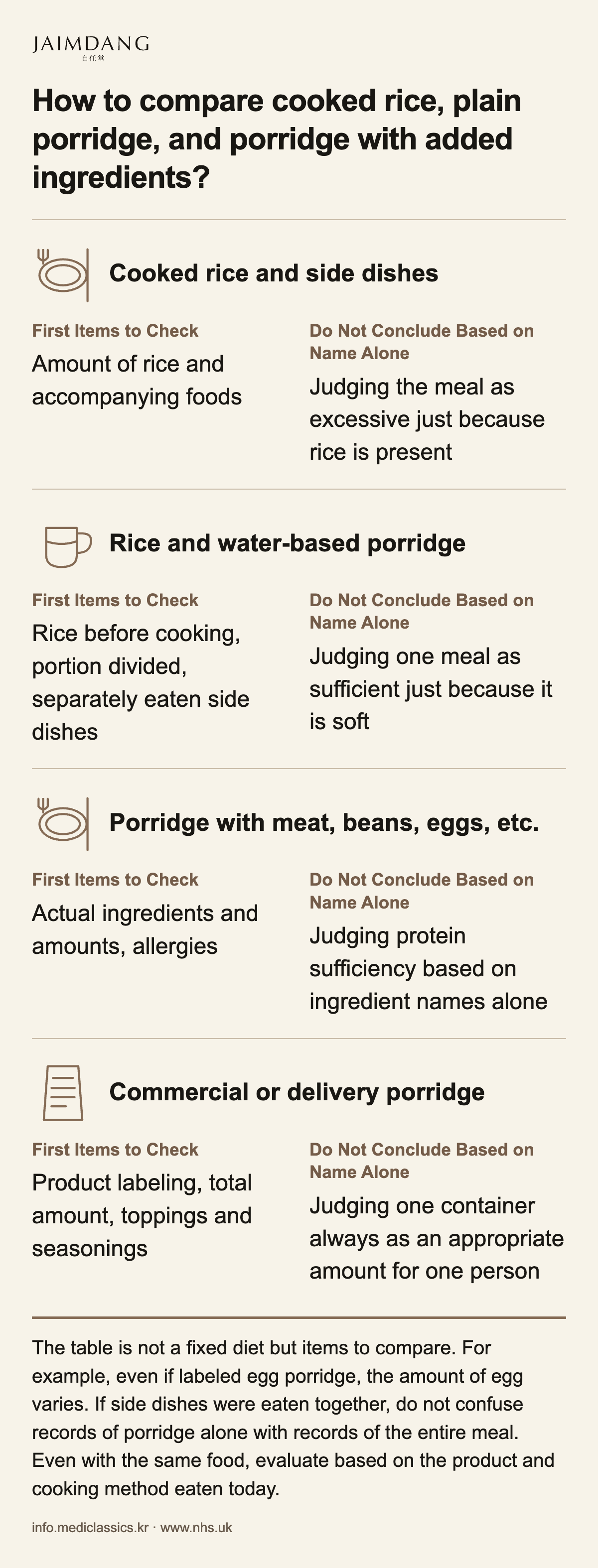
| Meal Type | First Items to Check | Do Not Conclude Based on Name Alone |
|---|---|---|
| Cooked rice and side dishes | Amount of rice and accompanying foods | Judging the meal as excessive just because rice is present |
| Rice and water-based porridge | Rice before cooking, portion divided, separately eaten side dishes | Judging one meal as sufficient just because it is soft |
| Porridge with meat, beans, eggs, etc. | Actual ingredients and amounts, allergies | Judging protein sufficiency based on ingredient names alone |
| Commercial or delivery porridge | Product labeling, total amount, toppings and seasonings | Judging one container always as an appropriate amount for one person |
The table is not a fixed diet but items to compare. For example, even if labeled egg porridge, the amount of egg varies. If side dishes were eaten together, do not confuse records of porridge alone with records of the entire meal. Even with the same food, evaluate based on the product and cooking method eaten today.
The UK NHS starch food guide explains rice as part of a meal and advises checking fats added during cooking or as accompaniments. Porridge may contain sesame oil, cream, sugar, or seasonings. This does not mean all such ingredients must be prohibited, but that adding much water does not erase the other ingredients from the record. It is easier to check missing foods when viewed together with Meal Check.
How can you compare your next meal?
First, briefly write the reason for choosing porridge and the original meal. “Plain porridge instead of cooked rice” and “plain porridge without rice or side dishes” are different changes. Writing not only what was added but also what was omitted shows the change in one meal. You can also check whether the change made meal preparation or managing hunger more difficult.
Second, if made at home, record the rice and additional ingredients and the portion divided after completion. If using already cooked rice, do not mix with records using raw rice. Nutritional amounts cannot be back-calculated from water quantity alone. If shared by the whole family, note that the portion may be estimated because the exact amount was not measured.
Third, check the foods eaten together. Examine whether usual protein foods or vegetables were included inside the porridge or remained as side dishes. If there are separate therapeutic diet guidelines, do not convert to a general meal plan. Changing the type of porridge is not a reason to change medication dosage or administration instructions by oneself.
Fourth, separately record whether it was easy to eat and the condition before the next meal. The feeling of softness in the mouth, post-meal discomfort, and later hunger are different items. Rather than judging all porridge as suitable or unsuitable from one experience, check whether the composition and amount differed. If discomfort continues or the amount that can be eaten greatly decreases, seek consultation rather than repeatedly changing food choices.
Fifth, check storage instructions for leftover porridge. The NHS advises refrigerating cooked rice within 1 hour if not eaten immediately and consuming within 24 hours. This is UK household rice storage guidance and does not guarantee the shelf life of porridge containing all ingredients. Follow instructions for commercial products after opening and avoid leaving large pots at room temperature for long periods. Specific storage principles can be found in Meal Prep and Safe Storage.
FAQ: Frequently Asked Questions
Does cooking porridge thinner always mean eating less?
Thickness alone cannot predict the actual amount eaten. Check whether multiple bowls were eaten and what additional ingredients and side dishes were included. Distinguishing bowl volume from total intake is key.
If it feels easy on the stomach, can I eat only plain porridge at every meal?
Feeling easy to eat does not mean long-term nutritional sufficiency. Examine the entire composition inside and outside the porridge, and if eating is restricted for treatment, confirm the period and composition with the responsible medical staff.
Do traditional food-therapy records prove that porridge causes weight loss?
Traditional usage records and modern clinical effects must be distinguished. This article explains the context of porridge use and does not promise weight loss amounts or treatment outcomes.
Sources
- Korea Institute of Oriental Medicine Korean Translation of Shiwu Bencao (Food Materia Medica), PDF page 22 (book page 21) jingmi (non-glutinous rice) entry: context of traditional literature dealing with porridge. Not used as modern treatment or infant feeding guidelines.
- NHS Starchy Foods and Carbohydrates: guidance on added ingredients during cooking and rice storage. Checked 2026-10-26.
Jaimdang Product Information is separate product information and this meal comparison is not evidence of product efficacy.
jaimdang Korean Herbal Care
Online consultation and prescriptions tailored to your constitution.
View products