
Diet Grocery Shopping Costs: Is Buying in Bulk Really Cheaper?
Buying diet ingredients in large packages is not always more economical. After comparing prices per unit, also consider your eating schedule, storage space, and the actual amount you will use. Even if you buy cheaply, if much is wasted and discarded, it may not be the right choice for your lifestyle. This article is not a meal plan guaranteeing weight loss for a specific amount, but a guide on what to compare when grocery shopping in stores.
Contents
What Does Comparing Grocery Shopping Budgets Mean?
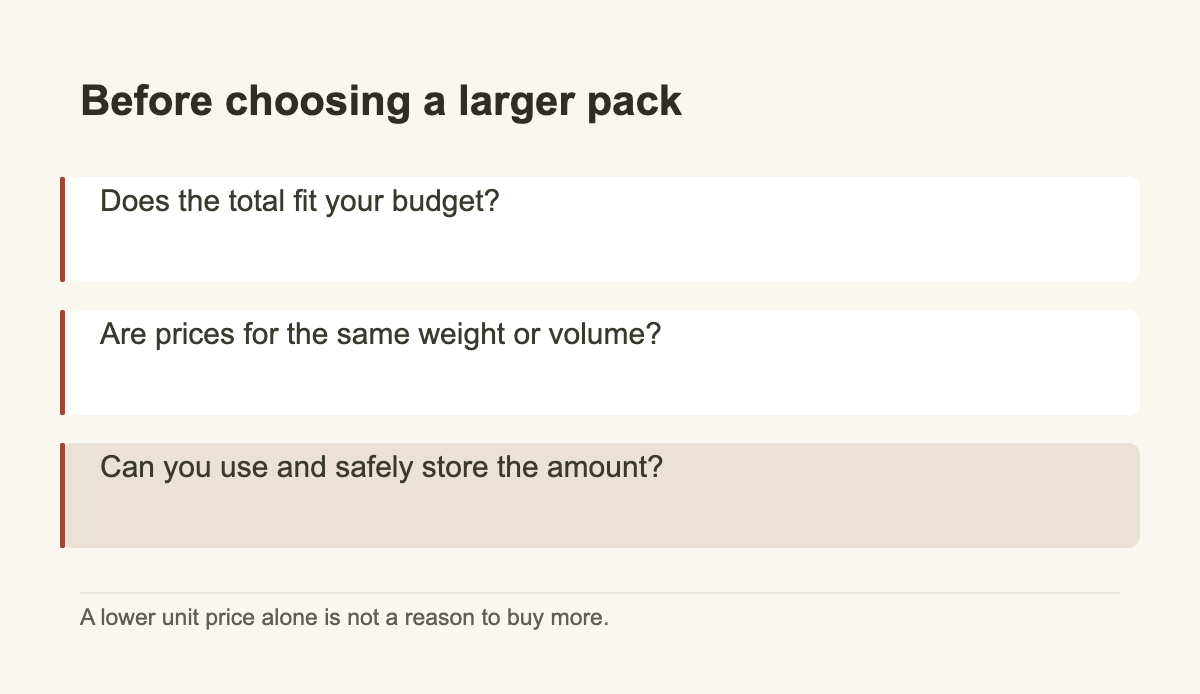
The price printed on the package is the amount you pay now, while the unit price is the price divided by the same weight or volume. These two prices answer different questions. If you have a fixed amount of money to spend today, you should look at the total amount first; to compare prices of similar products, you need to match the units. Buying beyond your budget just because the unit price is lower is not necessarily a good choice.
Health Canada’s budget guide suggests using a shopping list and comparing unit prices of products. Here, planning does not mean filling every meal with new food. You can first consider ingredients left at home, already scheduled dining out, and available preparation time, then decide what is lacking. The key is to connect the process of buying ingredients with the actual process of eating.
Even products that look like the same type may have different comparison conditions. Vegetables before trimming and those ready to cook, ingredients without sauce and completed dishes require different preparation efforts. Do not conclude that a higher price is irrational; check whether you can handle additional cooking and storage. Conversely, do not assume all nutritional compositions are the same just because a product is convenient.
In What Units Should Price Numbers Be Read?
For example, if two products are labeled with prices per 100g and per 1kg respectively, you need to convert them to the same standard to compare. Since 1kg equals 1,000g, the price per 1kg corresponds to ten times the 100g price. This is a unit conversion and does not indicate the actual selling price or savings effect of a product. This article does not create regional price lists that have not been verified.
Distinguish between the total package weight and the portion actually used. For foods packed in liquid, the net weight and drained weight may differ, and some ingredients have parts excluded during trimming. Instead of mixing different labels to create precise price rankings, note what basis was used for comparison. If information is insufficient in the store, it is better not to assume you know the exact cost.
Discount conditions are also part of the numbers. Check whether the price is a member price, applies only when buying multiple items together, or requires coupons or shipping fees. A large discount rate does not mean you are buying the amount you need for the least money. For food expense records, it is easier to compare future purchases if you record the actual payment amount and purchase quantity rather than the advertised original price.
How to Compare Small and Large Packages?
| Purchase Situation | Things to Check Together | Criteria for Next Choice |
|---|---|---|
| Fresh foods eaten alone | Eating dates and leftover amounts | Whether the package size is realistically consumable |
| Ingredients shared by multiple people | Preferences, allergies, usage schedule | Whether the ingredient is needed by everyone |
| Ingredients stored in the freezer | Available space and possibility of portioning | Whether storage according to package instructions is possible |
| Discount bundle products | Required quantity and total payment amount | Whether the plan is not extended just because of discounts |
This table is an editorial example to assist purchase decisions and does not mean that a certain package size is healthier. Some people find it convenient to buy small packages frequently, others prefer to divide the same ingredient across multiple meals. Even the same person may choose differently during weeks with business trips or family schedules.
For example, if you plan to buy tofu, do not stop at "the big pack is cheaper" but think about which meal and how you will use it. Plans to eat leftover tofu later should be checked along with the product’s post-opening storage instructions. Eating food whose storage conditions have already been missed just because it feels wasteful is not a budget management method. For detailed storage, see Meal Prep Safe Storage Guide.
What Grocery Shopping Procedures Should Be Applied in Stores?
First, check the ingredients available at home. Do not just count that they are in the refrigerator; check their condition and product instructions. Planning one or two meals centered on usable ingredients can reduce buying similar ingredients again. At this time, schedule examples are not diet prescriptions or intake frequency rules.
Second, divide the list into essentials and substitutes. Consider whether you can choose other vegetables if a specific one is unavailable, or change to a manageable form if cooking time is insufficient. Dietary restrictions due to allergies or diseases are not changed arbitrarily because of price. When available products are limited, first check whether they meet necessary conditions.
Third, check the total amount and unit price in order at the display. Even if using a phone calculator, verify that the entered unit is correct. You do not have to compare only within the same brand, but do not treat products with different raw materials and cooking processes as the same and compare only prices. Consider travel and time required for purchase as part of your living conditions.
Fourth, review items without planned use before checkout. Buying food outside the list is not necessarily a failure. However, knowing why you added it makes the next list more realistic. Briefly note reasons such as family requests, sudden schedule changes, or ingredients not available in the store. Do not change by arbitrarily removing entire food groups for savings.
Fifth, reflect on the next purchase after eating. Checking leftover ingredients along with receipts allows you to see differences between expected and actual usage. For ingredients repeatedly "not eaten," choose conditions to change among package size, cooking method, or purchase frequency. Do not decide the value of all ingredients based on one purchase result; use records to find recurring living conditions.
FAQ: Frequently Asked Questions
Do I Have to Buy Diet-Specific Products to Follow a Diet?
The name "diet-specific" alone does not determine whether it is necessary for your meals. You can first consider how to combine familiar grains, protein foods, and vegetables. When choosing products, check raw materials, nutrition labels, and actual consumption amounts rather than advertising phrases. Typical compositions can be linked to the Meal Check Guide.
Should I Skip Meals to Reduce Budget?
You need to consider purchase costs and required nutrition together. If skipping meals causes severe hunger or anxiety about eating, instead of making the budget stricter, look for realistic help and meal options. If food support is needed, you can check public support offices in your area, but this article does not guarantee eligibility or support amounts for any specific region.
Does Reducing Food Expenses Mean Better Weight Management?
Expense records and weight or meal status are different indicators. Lower food spending does not show that your meals are nutritionally adequate or that you have lost weight. Related Product Information is a path to check product contents and is not evidence for grocery savings or weight loss. The goal of this article is to enable you to explain purchase decisions suitable for your budget and lifestyle.
Reference Original Text
- Health Canada, Healthy eating on a budget: Use of shopping lists, unit price comparison, caution against overbuying. Text checked on 2026-10-20.
- NIST, Unit Pricing Guide: Distinction between selling price and unit price, comparison standards such as 100g and kg. Text checked on 2026-10-20. Not used as basis for domestic regulations or actual selling prices.
jaimdang Korean Herbal Care
Online consultation and prescriptions tailored to your constitution.
View products