
What should you record when emotions seem to influence eating?
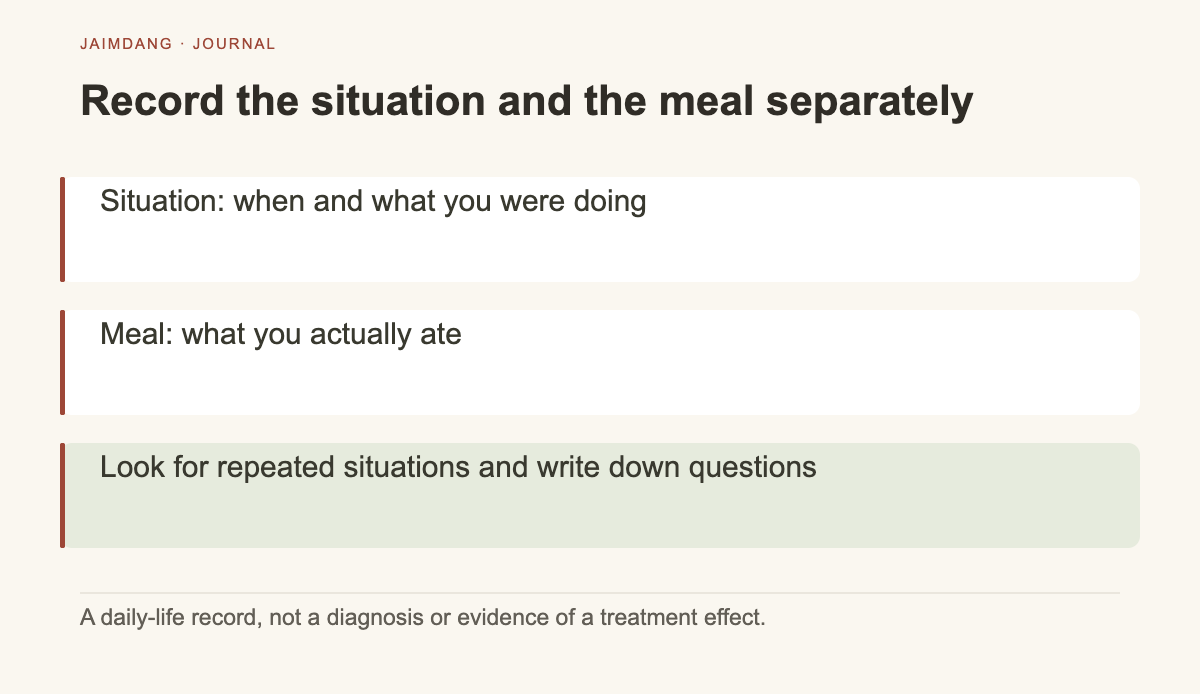
Record the situation, thoughts, feelings and hunger before eating, rather than counting food alone. Hunger and emotion can coexist. A diary should help identify needs and support, not supply evidence for blaming yourself.
Contents
What is emotional eating?
The term describes eating in response to feelings such as sadness, anxiety or anger. CUH also discusses habit, boredom, food availability and social situations as reasons for eating. Enjoying food with others is not by itself a disorder, and feeling that you ate a lot does not diagnose binge-eating disorder.
Repeated loss of control or substantial distress deserves professional assessment. Calling it weak willpower may prevent someone from seeking help.
What does a ten-point scale mean?
CUH describes observing the intensity of an urge on a ten-point scale. This is not a diagnostic score, calorie calculation or rule requiring you to delay eating until the number falls. Follow existing treatment advice for eating difficulties. Words such as “tired and hungry” are equally usable if numbers make the diary burdensome.
How does a situation record differ from a food list?
| Food entry | Context to add | Avoid assuming |
|---|---|---|
| Ate biscuits | Previous meal and hunger | The food proves emotional eating |
| Snacked after work | Fatigue, thoughts and breaks | Only rest or only food is needed |
| Ate with friends | Enjoyment and social setting | Shared pleasure is a problem |
| Ate alone with distress | Control and recurrence | A diary provides a diagnosis |
These are invented editorial examples, not patient stories. Describe events rather than judging them. If you were hungry, record whether enough food had been available earlier.
How can you start and use the diary?
Choose a simple format: time, place, food, preceding thoughts or feelings. Exact calorie counts and photographs are not required. Compare several entries for patterns such as long gaps between meals, work without breaks or conflict. Write “unsure” when you do not remember; do not reconstruct an emotion just to complete a box.
Match the response to the need. Plan access to food when meals are difficult to obtain, or consider opportunities for rest when exhausted. Recurrent anxiety or relationship difficulties may need support beyond stricter eating rules. Do not use distraction to suppress genuine hunger.
Keep observations separate from guesses. You may choose whether to share the diary; it should not become surveillance or control by someone else. Reduce or stop recording if it increases guilt, meal skipping, secrecy or constant thoughts about food. Discuss an appropriate method with a qualified professional.
When receiving Korean medicine care, describe sleep, appetite, digestive symptoms, bowel habits and medicines. The record cannot establish a constitutional diagnosis, and herbal treatment should not be assumed to resolve psychological distress alone.
FAQ
Is comfort from food always something to eliminate?
Food can provide pleasure and connection. Consider recurring distress and impact on daily life rather than condemning one reason for eating.
What if recording makes me feel guilty?
You do not need to persist with a harmful format. Simplify or pause it and discuss alternatives, especially during eating-disorder treatment.
When should I seek professional help?
Repeated loss of control, compensatory vomiting or excessive exercise, and food or weight worries that disrupt life warrant assessment. You need not wait until you know a diagnosis.
References and related reading
- Cambridge University Hospitals, Introduction to emotional eating
- Cambridge University Hospitals, A brief guide to tackling emotional eating
- NIH News in Health, Creating Healthy Habits
- Stress eating and emotional eating: understanding the pattern
Product information
jaimdang product guide. The practical guidance above does not establish the effectiveness of a product.
jaimdang Korean Herbal Care
Online consultation and prescriptions tailored to your constitution.
View products