
Sugar-Free Snacks: Traditional Sweet-Taste Categories and Nutrition Labels
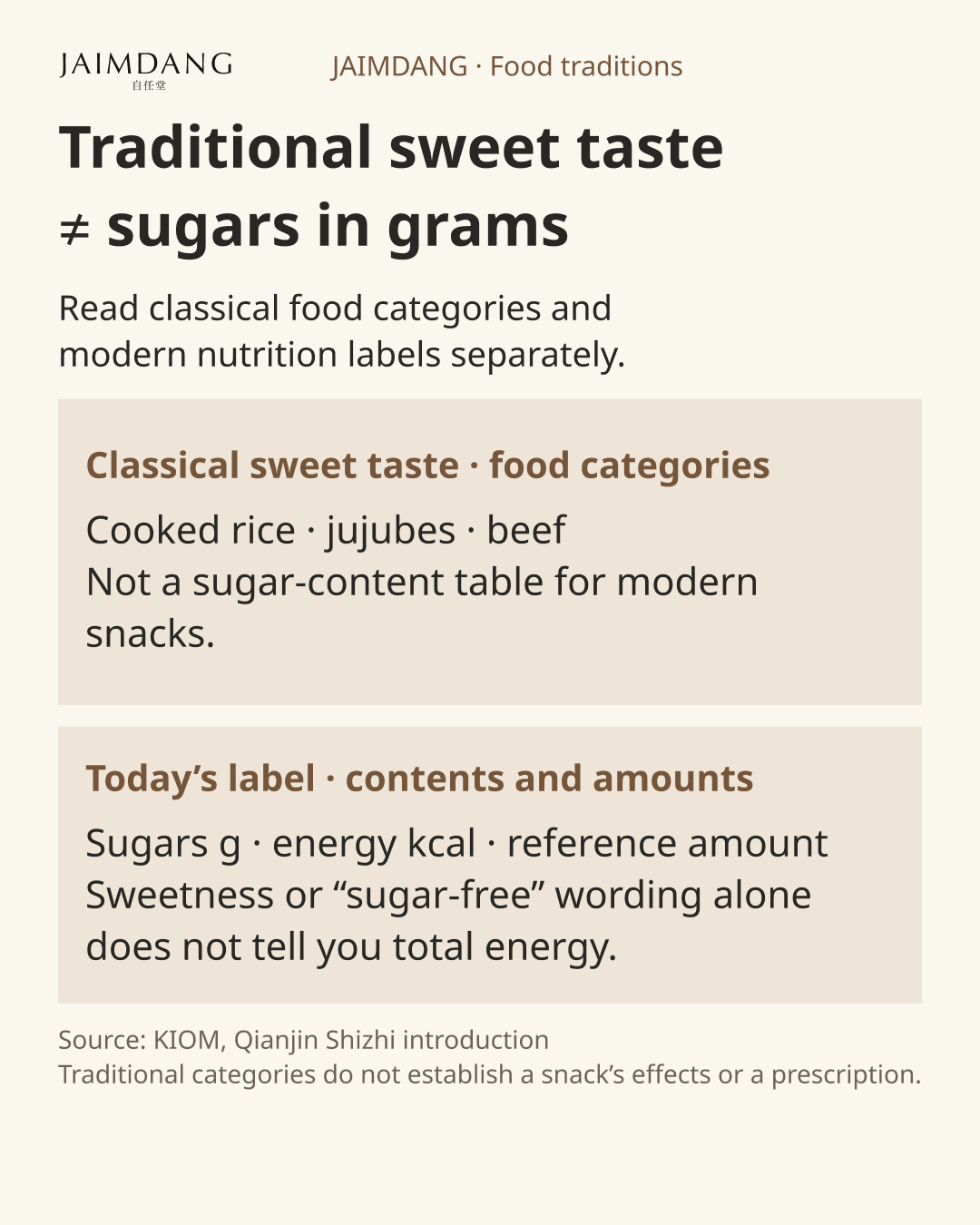
When sugar-free snacks taste sweet, confusion arises if gammi (sweet taste in traditional food classification) in Korean medicine and sugars on the label are read as the same meaning. Gammi is a category in traditional food descriptions, while sugars refer to the quantity of sugars listed on nutrition labels. This article separates three aspects when choosing packaged snacks: the context in which classical texts explained it, what is actually contained in the product, and how much one ate in which situation.
Contents
Does gammi in classical texts mean a certain number of grams of sugars?
The Korea Institute of Oriental Medicine’s Korean translation of 《Qianjin Shizhi (千金食治, Thousand-Gold-Piece Food Therapy)》 connects cooked rice, jujube, and beef to gammi in the introduction’s explanation of omi (five tastes) combinations. It is not a sugar content table collecting only foods with strong sweetness like modern snacks. The end section of seasonings in 《Sikmulboncho (食物本草, Food Materia Medica)》 also explains omi (five tastes) and the relationship with organs according to traditional theory, cautioning against excess. These two texts provide the basis for reading old sikchi (traditional Korean food-based care) explanations and are not clinical trials proving modern efficacy or harm of specific snacks.
Therefore, the expression “gammi enters the spleen” is not translated into a claim that sugar enhances the anatomical function of the spleen. Conversely, just because a product is sugar-free does not mean its taste, ingredients, and amount eaten have all been confirmed. There is no formula in these materials to convert traditional classification into current packaging numbers.
When looking at snacks, separate three questions
| Information Read | Actual Question Asked | Interpretation Not to Make |
|---|---|---|
| Gammi in sikchi (traditional Korean food-based care) literature | What foods and traditional context were explained? | Grams of sugars or specific organ treatment effects |
| Nutritional label of today’s product | What amount of which ingredient is contained per stated reference amount? | Determining values based only on the feeling of sweetness |
| Personal snack record | When, why, and how much was eaten? | Judging constitution or weight loss effects from a single choice |
The last row is a lifestyle memo suggested in this article, not a verified diagnostic method written in classical texts. Record whether you ate because you were hungry or while doing something else, and the actual amount, and read the product’s ingredient information separately. This is a method of not omitting the label based on traditional concepts or explaining one’s body condition by a single label.
Korea Institute of Oriental Medicine Korean Translation of Qianjin Shizhi (千金食治, Thousand-Gold-Piece Food Therapy): Introduction omi (five tastes) combination, Korean Translation of Sikmulboncho (食物本草, Food Materia Medica): End section of seasonings
Are “no added sugars” and “no sugars” the same question?
In the US FDA’s explanation of nutritional labeling, total sugars include naturally occurring sugars in the food and added sugars. Added sugars are the portion added during manufacturing or preparation. Therefore, adding total sugars and added sugars on US labels would double-count the same ingredient. FDA explanation of added sugars
This explanation is not applied as-is to packaging formats in all countries. Whether Korean or imported products provide certain items must be confirmed by checking the actual label. Do not fill in zero for added sugars just because you cannot find the added sugars section. The front label’s emphasized phrases, the back’s nutritional information, and the ingredient list are each information to check.
How Should I Interpret the Calorie Numbers on Sugar-Free Products?
You cannot judge that way. The FDA also separately addresses cases where sugar-free labeling is used but the product is not low-calorie. This US material is not converted into Korean labeling standards here; the point to confirm is that sugar-related wording does not replace total calories. FDA sugar-free labeling guidance
For example, if hypothetical snack A has 120 kcal per 30 g and B has 150 kcal per 50 g, comparing only the numbers 120 and 150 ignores different serving sizes. Comparing 30 g portions, B is arithmetically 90 kcal. Conversely, if you eat the entire package B, you use the labeled 150 kcal. This example is a calculation method, not a recommendation of specific products or appropriate snack amounts for everyone.
How to make notes comparing two products?
| Item to Check | Content to Write | Easily Overlooked Distinction |
|---|---|---|
| Product and packaging | Actual product name, total content weight | Different products with similar names |
| Labeling standard | Per 100 g, per serving, per total content | Whether compared at the same weight |
| Nutritional information | Calories, carbohydrates, sugars, fats, etc. | Judging overall by only one sugars row |
| Ingredients | Listed sweeteners and allergen information | Assuming the product is not sweet or is safe without checking |
| Actual amount eaten | Entire, divided portion, leftover amount | Serving size on label versus personal portion |
The table is not a scoring sheet to rank products. Also consider other conditions needed for choice such as price, taste, storage, allergies. Unit prices of small and large packages can be separately checked in Grocery Budget Unit Price Comparison.
What if the ingredient name “sugar alcohol” appears?
The FDA introduces sugar alcohol as a type of sweetener used in sugar-free candies and snacks. Different sweeteners are not all the same substance, nor is total calorie calculation based solely on the name sugar alcohol. FDA information on sweeteners
If discomfort recurs after eating, record the product name, amount eaten, and time symptoms appeared to bring for consultation. Records alone do not confirm a specific ingredient as the cause. Existing Dietary Fiber and Gas Guidance covers how to distinguish multiple foods changed simultaneously.
What is the procedure for reading the labels and recording the actual portion consumed?
First, write down the serving size and total content weight from the two packages you want to compare. Convert these values to the same weight for comparison purposes, and separately calculate the calories based on the actual amount you ate for your personal record. In the earlier example, B’s 30g equivalent of 90kcal and a whole 50g package at 150kcal are not contradictory. These differences arise from varying serving sizes, so be sure to note which value you recorded alongside the reference.
Next, document any accompanying foods or situations where you shared the food. Even if you only changed the snack, if the beverage or additional amounts you ate also varied, the sugar-free label alone cannot fully explain your choice that day. If you shared from a communal plate and don’t know your exact portion, avoid guessing grams; instead, note something like “shared, amount estimated” to reflect what you confirmed.
Finally, when revising previous records, leave a reason for the correction. For example, if you mistakenly treated a single-serving calorie value as the whole-package value, or forgot to include leftovers, adjust the label and amount accordingly. Such corrections do not imply sudden changes in your physical condition. These notes serve as tools to explain your choices and are not criteria for prescribing individual meal portions or rating foods as good or bad.
Reading food labels and deciding on medication use are separate considerations. Jaimdang Product Information is the official source to check product purposes and guidance; this article’s snack comparisons or calculation methods do not serve as evidence of product efficacy.
Frequently Asked Questions
If there is a ‘0’, do I not need to record the amount eaten?
First check which item and standard serving the number is attached to. Do not convert sugars labeling into calories or total package weight.
Is a product with low sugars always a better choice?
The needed information varies depending on what you want to compare. Consider allergies, actual amount, other nutrients, and your dietary guidelines together. This article does not replace personal dietary prescriptions such as for diabetes.
Are the sweetness described in Korean medicine and sugars on the label the same?
Traditional taste classification and modern nutritional labeling ingredient amounts are different information. Do not judge sugars content, constitution, or weight loss effects by taste or color alone.
jaimdang Korean Herbal Care
Online consultation and prescriptions tailored to your constitution.
View products