
Should You Start Walking Immediately After a Meal? Separating Traditional Health Advice from Research Timing
If you want to walk after a meal, do not think that everyone must wait the same number of minutes and walk at the same pace. First, check the amount eaten, comfort inside the stomach, the environment for movement, and your own exercise guidelines. Traditional health-cultivation literature used in Korean medicine discusses walking after meals as part of daily life. The starting point is not to convert the walking times set by modern research into proof of the effects of the classics, nor to interpret post-meal walks as completely offsetting what was eaten.
Contents
How does traditional health cultivation describe walking after meals?
In 『Beiji Qianjin Yaofang』 Volume 27, health-cultivation chapter, there is a passage about the practice of walking after finishing a meal. It is a traditional record that does not regard eating and activity as separate events but treats them within the order of daily life. The distance units or expressions related to digestion and longevity in the literature of that time are not brought as walking prescriptions applicable to all readers today.
When thinking about today’s post-meal walk, what can be referenced from this literature is the perspective of observing life after eating. It actually looks at what and how much was eaten, how comfortably one moved, and whether there was any discomfort. This life observation must be distinguished from measuring clinical effects to utilize traditional literature without exaggeration.
Post-meal walks are also distinguished from high-intensity exercise. Unlike comfortable movement around the house, running, fast uphill walking, or heavy strength training place different demands on the body. If the short phrase “it is good to move after eating” is taken as an immediate start signal for all exercises, one may overlook their own condition. This article is a guide for planning the timing of activity and does not provide detailed prescriptions for exercise intensity.
What do the 15 minutes and 45 minutes in the study represent?
The 2013 randomized crossover study by DiPietro et al. involved 10 participants aged 60 or older with low usual activity and risk of blood sugar control issues. It compared three 15-minute post-meal walks with one 45-minute walk, observing short-term blood sugar responses in an indoor research environment. These numbers are study conditions. They are not figures proving the same weight loss effect or optimal walking time for all ages.
Improved blood sugar results after post-meal walking do not establish that participants lost weight. The limited participant number, target group, and observation period mean the study should not be generalized as a promise that “anyone will lose weight by walking a few minutes after eating.” Just because both the classical post-meal walking and the study deal with walking does not mean their explanatory systems and levels of evidence are the same.
Therefore, the time indicated in the study should not be taken as a mandatory standard to be met today. If you have received guidelines on timing of activity and blood sugar management due to your illness or medication, prioritize those instructions. The conclusion of this study does not support reducing prescribed medication or significantly changing meals just because you took a walk. If you need to check health indicators, follow the methods set by your healthcare provider.
What should we compare depending on the post-meal situation?
| Post-meal situation | Conditions to examine | Points to adjust the plan |
|---|---|---|
| Finished meal comfortably | Safe route and remaining schedule | Confirm if movement without strain is possible |
| Ate more than usual and feel discomfort | Presence of fullness or pain in the stomach | Do not increase pace to compensate for the meal |
| Short lunch break | Return time and route safety | Avoid plans to rush and cover long distances |
| Have personal guidelines such as diabetes medication | Instructions for activity, meals, and symptom management | Prioritize personal guidelines over general walking examples |
The above table is not a self-assessment tool to automatically decide whether to walk. Do not use it as a basis to continue walking despite discomfort by saying "I need to digest." In Korean medicine consultations, asking about post-meal condition is to synthesize various observations, not to definitively diagnose a specific organ problem based on a single symptom like bloating.
Recording both meal size and movement environment together makes it easier to explain why the same walk felt different. For example, a day when you walked on flat ground after a usual lunch and a day when you hurried up stairs after a large meal are different comparison conditions. Do not conclude that the burden was the same just because the walking time was equal. Instead of increasing records, leave one or two sentences describing the conditions where actual differences occurred.
What is the procedure to prepare for a post-meal walk?
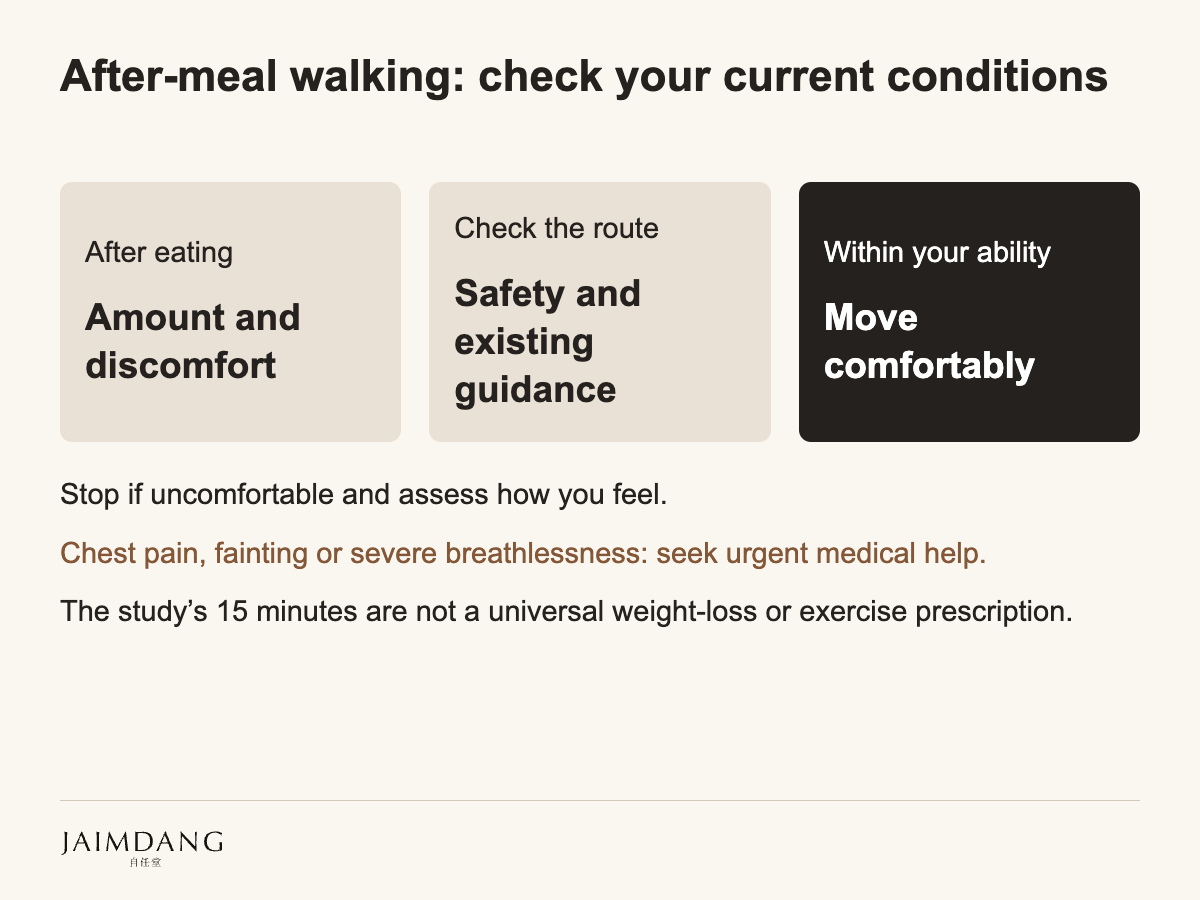
First, finish your meal and check your body’s condition. There is no need to rush to get up due to device targets while still eating. Observe your current hunger or fullness and any unusual discomfort compared to usual. Do not try to convert meal size into walking time to compensate.
Second, decide on a safe route for movement. Consider building entrances, vehicles, floor conditions, and traffic signals. Rather than going far and running back during a short break, find a route that allows movement within actual available time. If walking indoors, check other users’ passage and workplace rules. More on location selection can be found at Indoor Walking When Weather Is Bad.
Third, move within a feasible range and check for discomfort. Do not add high-intensity exercise that was not previously done just because it is after a meal. If you are resuming daily activities or have movement restrictions, plan within the guided range. Do not judge the fact that you stopped as a lack of willpower; instead, write down the reasons why you stopped.
Fourth, record your condition after the activity. Distinguish between post-meal comfort, fatigue, pain, and the actual range of movement possible. If you felt comfortable, consider whether you can continue under the same conditions; if you felt discomfort, do not simply try to adapt by walking more. Repeated symptoms can be organized along with meal types and times, and medication intake, to be used as consultation material.
Fifth, view the day’s walk together with overall activities. The fact that you moved briefly after a meal does not replace the entire day’s activity plan. Conversely, if there was a meal after which you could not walk, it does not mean you must double the next time. Refer to Starting Walking and Strength Activities to compose a sustainable plan in your lifestyle.
FAQ: Frequently Asked Questions
Must I walk immediately after eating?
This article does not present an immediate-start rule applicable to everyone. Distinguish the specific timing of research and your own meal and body condition. Instead of enduring discomfort to meet a schedule, confirm personal guidelines and a safe environment. Do not rush finishing your meal or reduce necessary rest because of walking.
Does walking offset all the food I ate?
Do not connect food and activity as penalties and rewards. Observations of blood glucose in post-meal walking studies cannot be converted into offsetting all food calories or reducing body fat. Jaimdang product information also does not prove the effect of specific walks or guarantee a method to compensate for meals.
What if I experience chest pain or severe dizziness while walking?
Stop the activity, secure safety, and seek medical help. Urgent symptoms such as chest pain, fainting, or severe shortness of breath require immediate emergency evaluation. Do not dismiss these symptoms as temporary post-meal reactions or a matter of body constitution. If you have individual hypoglycemia management guidelines, follow those as well.
Original sources
- 『Beiji Qianjin Yaofang』 Volume 27 health-cultivation chapter: Traditional literature concerning walking after meals. Distance and longevity expressions are not applied as modern individual prescriptions. Confirmed on 2026-10-21.
- DiPietro et al., Diabetes Care 2013, original study abstract: Short-term crossover study with 10 participants aged 60 or older, comparing three 15-minute post-meal walks with one 45-minute walk. Not generalized to weight loss outcomes. Confirmed on 2026-10-21.
- NIDDK, Staying Active at Any Size: Safety and warning symptoms during activity. Individual exercise guidelines should be confirmed separately.
jaimdang Korean Herbal Care
Online consultation and prescriptions tailored to your constitution.
View products