
Do I Have to Replace Meals with Detox Juice to Practice Traditional Dietary Nourishment?
There is no need to replace meals solely with juice just because you are practicing traditional dietary nourishment. The perspective of examining the roles of various foods in traditional dietary nourishment and the advertising claims that juice removes toxins from the body require different bases. When choosing a new beverage for weight management, check not only what you drink but also what you are replacing with that beverage.
Contents
What Do Traditional Dietary Nourishment and Detox Mean?
The end of the Zang Qi Fa Shi Lun section in the 《Huangdi Neijing Suwen》 explains traditional dietary nourishment by distinguishing grains, fruits, meats, and vegetables. While the compositional perspective of such literature can be referenced in daily life, it does not represent results from testing any specific modern juice product. Traditional explanations of food properties, flavors and vital qi are not to be understood as modern toxin concentrations or organ function tests.
Even when an advertisement borrows the language of traditional Korean dietary nourishment, check what the program actually involves. It is important to know what is excluded and what is consumed, whether individual conditions are considered, and what evidence supports the claimed outcomes. The history of “being eaten since ancient times” does not replace clinical trials demonstrating a specific product’s weight loss effect. It is necessary to separately inquire about the long-term use of foods and the efficacy and safety of modern products.
In this article, detox refers to expressions used in juice and diet programs marketed to general consumers. It is not mixed with medical treatments for actual poisoning or withdrawal treatments for alcohol dependence. Also, occasionally drinking juice and replacing all meals with beverages for several days are different in scope. Rather than judging a single food like juice as bad, the method of use is distinguished.
How Should the Year of Studies and Weight Loss Figures Be Interpreted?
The US NCCIH explains that human studies on detox programs are limited and have constraints such as study design and participant numbers. The 2015 review introduced in the guidance concluded that persuasive studies supporting weight management or toxin removal are lacking, and the 2017 review explained that initial weight changes may be related to low intake and can increase again after returning to usual meals. This does not mean everyone necessarily experiences the same course.
Even if you see the number of kilograms lost in a few days in advertisements, that number alone does not reveal the amount of fat loss or toxin excretion. To understand the cause of weight change, measurement conditions, actual intake, comparison targets, and observation periods must be checked. Do not treat an individual case’s weight-change figure as an average effect, and also check whether comparisons were made with times when juice was not consumed.
This article does not specify a safe duration in days. The program length set by a product does not mean it is suitable for an individual. If you have dietary guidelines due to kidney disease, diabetes, or are taking medications, do not arbitrarily change meals and medications according to internet schedules. Plans that greatly restrict current intake must consider individual conditions.
How to Compare Questions About Traditional Dietary Nourishment and Advertising Claims?
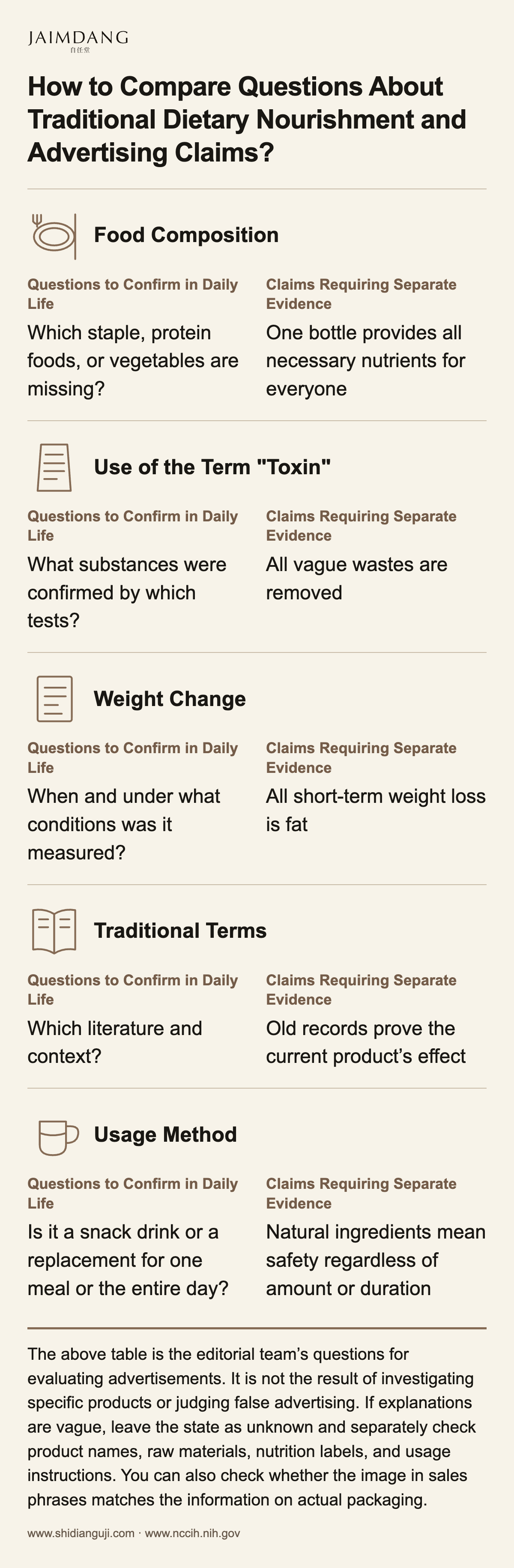
| Item to Check | Questions to Confirm in Daily Life | Claims Requiring Separate Evidence |
|---|---|---|
| Food Composition | Which staple, protein foods, or vegetables are missing? | One bottle provides all necessary nutrients for everyone |
| Use of the Term "Toxin" | What substances were confirmed by which tests? | All vague wastes are removed |
| Weight Change | When and under what conditions was it measured? | All short-term weight loss is fat |
| Traditional Terms | Which literature and context? | Old records prove the current product’s effect |
| Usage Method | Is it a snack drink or a replacement for one meal or the entire day? | Natural ingredients mean safety regardless of amount or duration |
The above table is the editorial team’s questions for evaluating advertisements. It is not the result of investigating specific products or judging false advertising. If explanations are vague, leave the state as unknown and separately check product names, raw materials, nutrition labels, and usage instructions. You can also check whether the image in sales phrases matches the information on actual packaging.
Applying traditional dietary nourishment to today’s meals can be thought of more in terms of “how a meal is composed” rather than “how much toxin is removed.” This is an editorial interpretation based on classics, not a clinically verified standalone treatment. The key point is to distinguish adding one food from removing several food groups; these changes should not be treated as equivalent.
What Are the Steps to Check Before Choosing Juice?
First, define the situation you want to change. Write down whether you intend to drink juice instead of an afternoon snack or eliminate the entire breakfast. Even drinking the same product differs depending on what food is omitted and daily life. If you seek a beverage because meal preparation is difficult, you can also compare other options that reduce time while maintaining meal composition.
Second, check the raw materials and actual quantity. Even if several fruit and vegetable names are included, it does not mean all nutrients are sufficiently provided. Distinguish added sugars or concentrates, the amount per bottle, and the amount you will drink. Composition and Quantity of Beverages helps with questions focusing on the beverage itself. This article also addresses decisions to replace entire meals with that beverage.
Third, review the remaining meals. Records differ depending on whether usual foods were eaten after adding juice or multiple meals were eliminated. Simply writing “healthy juice” makes it difficult to know what changed. Use the Meal Composition Check items to verify missing foods and existing guidelines.
Fourth, check safety information. NCCIH explains infection risks from some unpasteurized juices, nutritional issues from restrictive diets, and diarrhea and dehydration risks from programs including laxatives. This information does not mean the same problems occur in all juices. Use it as a question to check actual product processing and storage methods and whether supplements or medicines are included separately. Do not omit verification just because raw materials are natural.
Fifth, do not interpret bodily reactions as evidence from advertising phrases. Do not record diarrhea after drinking as proof that toxins were removed. Record new products, usual meals, and medications together, and do not force continued use if discomfort occurs. Consult medical professionals for severe or persistent symptoms. It is important not to evaluate that tolerating discomfort means better effects.
Finally, consider meals after the program. Consider whether the plan depends on using particular bottled products or powders, or whether it can fit into ordinary grocery shopping and meal preparation. Choosing more expensive products or longer restriction periods does not mean better practice of traditional dietary nourishment. You should be able to explain what will actually change in daily life before purchase.
FAQ: Frequently Asked Questions
Should I Not Drink Vegetable Juice?
This article does not prohibit all vegetable juices. It distinguishes between drinking as a beverage and continuing to replace meals, and advises checking actual composition and personal guidelines.
Can Phlegm-Dampness in Traditional Korean Medicine Be Removed by Detox?
Phlegm-dampness in traditional Korean medicine is a term from the traditional diagnostic system and is not the same as unspecified toxins mentioned in advertisements. Do not confirm phlegm-dampness in traditional Korean medicine based on a single piece of information such as swelling or weight gain, nor judge that a specific juice treats it.
Is It Safe If I Do It for Just a Few Days?
This article cannot specify a safe number of days for everyone. Ingredients, medicines, health status, and degree of dietary restriction vary. If you have personal guidelines, prioritize them over general programs.
If My Weight Decreased, Does That Confirm Effectiveness?
Changes on the scale and judgments about causes differ. Without measurement conditions and long-term follow-up, you cannot conclude fat loss or toxin removal.
Sources
- Huangdi Neijing Suwen Buzhu Shiwen Zang Qi Fa Shi Lun: Explanation of traditional dietary nourishment of grains, fruits, meats, and vegetables. Not evidence of modern detox program effects.
- NCCIH, Detoxes and Cleanses: Research limitations and safety issues. Text confirmed on 2026-10-26.
Jaimdang Product Information is a separate route to check product information, and this article does not recommend specific products as meal replacements or detox methods.
jaimdang Korean Herbal Care
Online consultation and prescriptions tailored to your constitution.
View products