
What Should You Check If Your Muscles Hurt the Day After Exercise? Should You Rest?
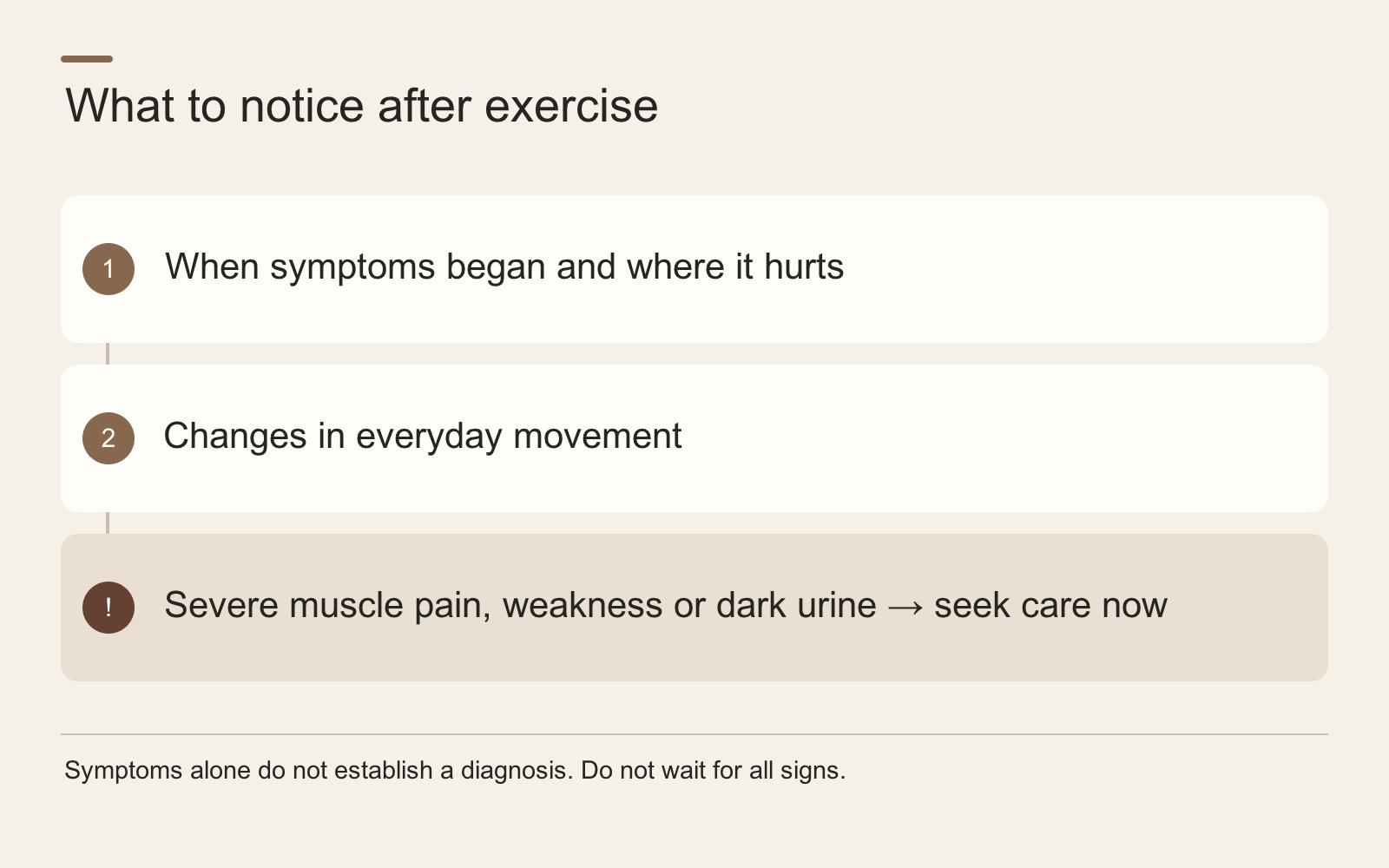
If your muscles hurt the day after exercise, do not evaluate the quality of your workout based solely on the degree of pain. Instead, examine when the pain started, where it hurts, and how much your usual movement has changed. You may experience delayed onset muscle soreness (DOMS) after unfamiliar exercise, but not all pain can be explained by this term. If sudden severe pain occurs or there is significant swelling or weakness, an evaluation is necessary before repeating the same exercise.

What Is Delayed Onset Muscle Soreness?
Delayed onset muscle soreness refers to muscle discomfort that appears some time after an unfamiliar strain. The American College of Sports Medicine (ACSM) distinguishes it from acute pain that occurs immediately during activity. Movements involving muscle lengthening while under tension may be particularly involved. For example, slowly lowering a weight or supporting the body while going downhill imposes different stresses than the upward movement.
However, knowing the type of exercise does not allow a definitive cause of pain to be determined. Even with the same “leg pain,” descriptions vary depending on whether it is a broad dull ache, a sharp pain at a single point, or a catching sensation when moving a joint. Records are intended to differentiate and communicate symptoms, not to serve as a home diagnostic checklist for injury. The absence of pain is not evidence that the exercise was ineffective.
How Should the Timing Numbers Be Interpreted?
ACSM materials explain that delayed onset muscle soreness typically begins 12–24 hours after exercise and may peak between 24–72 hours. These ranges describe typical patterns. The fact that pain occurs within this timeframe does not guarantee safety, nor does it mean one must endure pain until 72 hours have passed. Injuries occurring during exercise and serious abnormalities appearing days later should be evaluated separately.
When recording time, distinguish between the time exercise ended, when discomfort first appeared, and whether it has worsened since. For example, “No discomfort during evening exercise, but discomfort on stairs the next morning” describes the situation. There is no need to speculate on causes or diagnoses. Numbers serve as tools to organize experience and do not guarantee a fixed recovery schedule.
How to Compare Stiffness and Warning Symptoms?
| Scene to Observe | What to Record | Caution for Next Judgment |
|---|---|---|
| General stiffness after unfamiliar movements | Start time, location, changes | Do not confirm diagnosis even if similar to common patterns |
| Sudden pain in one area during exercise | Movement at the time and any collision or sprain | Do not push through the pain and repeat the movement to test it. |
| Swelling or difficulty walking/weight-bearing | Limitations in daily activities and worsening | Do not dismiss as mere exercise effect |
| More severe muscle pain/weakness than expected or dark urine | Time course of exercise and symptom onset | Seek immediate medical evaluation |
The last row reflects warning signs of rhabdomyolysis as described by the CDC. If you have dark brown or cola-colored urine, unexpectedly severe muscle pain, or weakness that makes usual tasks difficult, seek medical help immediately. Not all symptoms need to be present simultaneously. Diagnosis cannot be made by symptoms alone and requires medical evaluation such as blood tests.
The NHS advises prompt help if pain or swelling worsens after injury or if weight-bearing is difficult. Emergency evaluation is needed if the injured area changes shape, loses sensation, or the skin becomes cold or discolored. The comparison table in this article is not intended to justify waiting in such situations.
What Is the Procedure for Deciding the Next Exercise?
First, check your current condition before completing the planned repetitions. If sharp pain occurs during exercise or movement changes noticeably, stop the activity and seek necessary help. Do not assess injury by repeating movements to see if the pain “loosens.” If you have already been prescribed treatment or rehabilitation exercises, follow the instructions from your provider first.
Second, record the course of discomfort and actual activity together. Note what exercises were done and what equipment, repetitions, or inclines differed from usual. Do not pre-judge results such as “muscle soreness was severe, so it was effective.” Starting Strength Training and Load Progression addresses other questions about setting initial exercise volume. This record is used to link the response after exercise back to that plan.
Third, avoid activities that worsen symptoms and adjust the next plan. If a pattern repeats where you do a lot on days with less pain and then rest completely the next day, reconsider the schedule itself. Guidance from Kingston and Richmond NHS explains how patients who have had physiotherapy evaluation can break activities into manageable units. Their pain score criteria are not applied as-is to all readers without evaluation.
Fourth, record responses after resuming exercise. Do not conclude recovery is complete just because you rested once; observe usual movement and responses during exercise together. Avoid plans that try to compensate all missed exercise at once and decide how to restart under current conditions. If recovery is difficult or discomfort recurs, seek professional evaluation to identify causes and activity plans.
FAQ: Frequently Asked Questions
Do I Have to Have Muscle Pain to Know I Exercised Properly?
Do not use pain as a goal or score. Exercise records can document whether learned movements were performed stably and their impact on daily life. Adding weight or repetitions to increase pain makes it difficult to establish an appropriate exercise plan. Explaining the body’s response and judging fat loss effects are different tasks.
Can I Test If Light Movement Is Okay by Trying It Myself?
If warning signs such as severe pain, swelling, or weakness are present, do not try to confirm by exercising. If you have already been evaluated, proceed within the prescribed activity range. There is no universal guidance for the same stretching or recovery time for everyone. Sometimes accurately describing current symptoms is more necessary than adding movements seen online.
Can I Continue Planned Exercise After Taking Herbal Medicine or Painkillers?
Do not assume the cause is resolved or that intense exercise is safe just because pain feels reduced. Inform your provider about any medications, herbal medicines, supplements you are taking, and the timing of symptom onset. Do not arbitrarily increase doses. Related product information provides a route to check product contents but does not guarantee muscle soreness recovery or replace medical care.
Reference Sources
- ACSM, Delayed Onset Muscle Soreness: Explanation of timing and unfamiliar load/muscle lengthening actions. Checked 2026-10-19.
- CDC, Signs and Symptoms of Rhabdomyolysis: Severe muscle pain, weakness, dark urine, and need for immediate evaluation. Checked 2026-10-19.
- NHS, Sprains and strains: Guidance on prompt help and emergency evaluation symptoms after injury. Checked 2026-10-19.
- Kingston and Richmond NHS, After your physio appointment: Adjusting activity pace for patients who have been evaluated. Does not apply individual rehabilitation instructions directly to general readers. Checked 2026-10-19.
jaimdang Korean Herbal Care
Online consultation and prescriptions tailored to your constitution.
View products