
After Switching to Decaf Coffee, How Can You Track Meals and Sleep through Yangsaeng?
Contents

What Is the Lifestyle Rhythm Mentioned in Yangsaeng?
To observe changes after switching to decaffeinated coffee, try recording not only the coffee name but also the times of meals and sleep. Yangsaeng in traditional Korean medicine is a perspective on caring for health in daily life. Among its principles are moderation in eating and drinking and regularity in daily activities. Applying these principles to today’s beverage records helps us distinguish a change in one drink from changes in the wider daily routine. Drinking decaffeinated coffee does not mean weight loss or insomnia treatment.
In the <i>Huangdi Neijing · Suwen</i>, the chapter on "Shanggu Tianzhen Lun" contains the phrase ‘食飲有節, 起居有常’ (There is moderation in eating and drinking, and regularity in rising and resting). This is a traditional principle of lifestyle emphasizing moderation in consumption and consistency in daily activities. This article uses this phrase as a starting point to examine the timetable of meals, beverages, and sleep. The classic text does not explain decaffeinated coffee or caffeine metabolism, nor does it present traditional principles as modern clinical trial results. Original text comparison, Shanggu Tianzhen Lun, Chapter 1
For example, if you are concerned that “even after switching coffee, you still crave snacks at night,” you can record what you drank, whether dinner was late, and if the waking time the next day changed. This makes the daily routine easier to describe rather than attributing one item as the cause. Records alone do not determine constitution or traditional Korean medicine diagnoses.
How Should Caffeine Levels Be Interpreted?
Modern product information should be checked separately. The U.S. FDA explains that an 8 US fluid ounce (about 237 mL) serving of decaffeinated coffee typically contains 2–15 mg of caffeine. This does not mean all decaffeinated products have the same content. It can vary depending on the product or extraction method, so prioritize the information provided for the product you consumed. FDA Caffeine Information
If you cannot find the information, write “unconfirmed” in the record field. Do not substitute 0 mg or the maximum of the range. Also, separate the cup size and the actual amount consumed. If you ordered a large cup but drank only half, the record of the ordered volume differs from actual intake.
If the content label mixes “per cup” and “per 100 mL,” first standardize the basis. Avoid making the calculation overly precise without knowing the exact product content and amount consumed. This step is to confirm caffeine exposure, not to judge moderation or an appropriate amount for the individual by a single number.
The FDA explains that sensitivity to caffeine and the rate at which the body processes it vary among individuals. Therefore, this article does not set a uniform last coffee time or allowable number of cups for everyone. Personal circumstances such as medications, health status, pregnancy, and breastfeeding should be reviewed separately with healthcare professionals.
What Is the Difference Between Coffee Records and Lifestyle Rhythm Records?
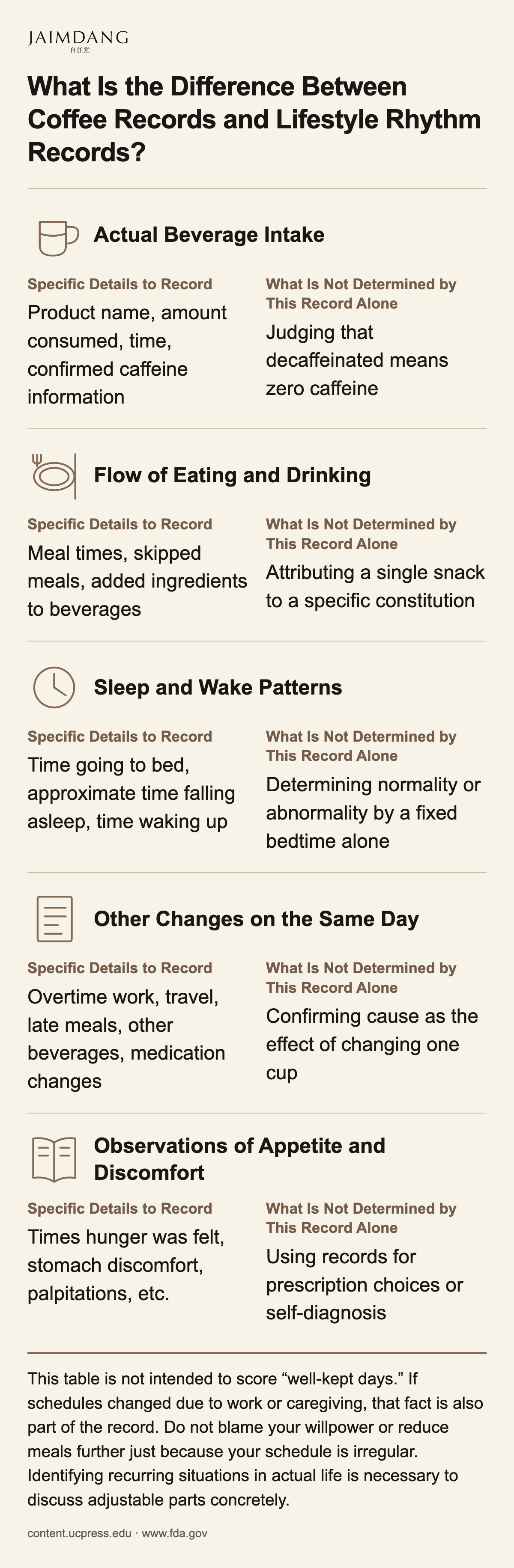
The following table is an editorial example of lifestyle observation and is not a classical prescription or validated diagnostic chart. The perspective of Yangsaeng broadens the scope of records to ask not only “how much was consumed” but also about that day’s meals and daily activities. The product’s caffeine content and lifestyle observation results are placed in separate columns.
| Focus of Record | Specific Details to Record | What Is Not Determined by This Record Alone |
|---|---|---|
| Actual Beverage Intake | Product name, amount consumed, time, confirmed caffeine information | Judging that decaffeinated means zero caffeine |
| Flow of Eating and Drinking | Meal times, skipped meals, added ingredients to beverages | Attributing a single snack to a specific constitution |
| Sleep and Wake Patterns | Time going to bed, approximate time falling asleep, time waking up | Determining normality or abnormality by a fixed bedtime alone |
| Other Changes on the Same Day | Overtime work, travel, late meals, other beverages, medication changes | Confirming cause as the effect of changing one cup |
| Observations of Appetite and Discomfort | Times hunger was felt, stomach discomfort, palpitations, etc. | Using records for prescription choices or self-diagnosis |
This table is not intended to score “well-kept days.” If schedules changed due to work or caregiving, that fact is also part of the record. Do not blame your willpower or reduce meals further just because your schedule is irregular. Identifying recurring situations in actual life is necessary to discuss adjustable parts concretely.
How Should the Recording Procedure for Comparison Begin?
First, record one product you drank today. Note whether it was regular or decaffeinated coffee, if milk or syrup was added, and how much was consumed. If you have packaging or order details, refer to them when confirming the product name. Leave unknown content as unconfirmed.
Second, record the meal and sleep times on the same day alongside. This allows you to see whether only the beverage changed or if meal intervals or overtime schedules also changed. You do not need to control all conditions other than caffeine to record. It is important not to hide changed conditions.
Third, write hunger or discomfort as facts rather than interpretations. Instead of “not suitable for constitution,” write “felt hungry in the afternoon,” or “could not fall asleep for a while after lying down.” Indicate approximate memories as such. You do not need to continuously monitor your body or drink more coffee to check reactions for recording.
Fourth, when reviewing multiple days’ records, separate same conditions and changed conditions. Do not conclude that a good night’s sleep was caused by changing coffee. If late meals and sleep schedules changed together, mark them separately. This comparison is a process of organizing personal experience, not an experiment proving weight loss effects.
Fifth, bring your records to a healthcare consultation if discomfort keeps returning. In traditional Korean medicine consultations, you can use detailed sequences of meals, sleep, and discomfort symptoms. However, this does not replace additional questioning and judgment needed in clinical care. Do not arbitrarily change medications or test restricted beverages without medical advice.
Frequently Asked Questions
Should I Quit Coffee First to Practice Yangsaeng?
The classical phrase in this article is not a directive for everyone to quit coffee. It is a principle to reflect on moderation and regularity in life. Judgments about coffee intake should be made separately based on actual product information and personal circumstances. Yangsaeng does not create uniform prohibition lists.
Will Switching to Decaffeinated Also Reduce Weight?
Switching alone does not promise weight loss. You must consider the amount consumed, added ingredients, and overall meals together. This record sheet is not a calorie prescription or appetite suppression method. Do not attribute weight changes solely to one coffee.
What Should I Change First While Recording?
This article does not prescribe what individuals should change first. Start by accurately recording product information and daily flow so you can identify what conditions have changed. Feasible lifestyle adjustments consider your work, meals, and sleep situations together. If discomfort recurs or is severe, do not delay clinical care to complete records.
Do Classical Lifestyle Principles Prove the Effects of Caffeine?
No. Yangsaeng principles are a traditional perspective on lifestyle, and caffeine content and sensitivity are separately confirmed by modern data. Distinguishing the scope of these explanations prevents misunderstanding traditional terms as equivalent to modern physiological actions.
Today, try recording meal and sleep times side by side with the coffee name and amount. Moving beyond filling numbers to reading the flow of the day is the beginning of Yangsaeng recording proposed in this article.
This article provides general health information and does not replace individual diagnosis or prescription.
Related reading: preparing meals for shift work
If you take Korean herbal medicine, check the product information alongside your actual prescription instructions. Do not change how you take it based on product information alone.
jaimdang Korean Herbal Care
Online consultation and prescriptions tailored to your constitution.
View products