
Raw or cooked vegetables: do you have to choose just one?
It is not necessary to eat only cold salads to include vegetables in your diet. Cooked vegetables are also an option, and rather than concluding that one form is universally better, consider the type of vegetable, actual quantity, cooking method, and accompanying foods. Utilizing the perspective of traditional Korean food therapy, instead of creating a rule that "warm is always better," you can start by asking how to put together a meal you can comfortably eat.
Contents
What is the role of vegetables in traditional dietary nourishment?
The 《Huangdi Neijing Suwen》 Zang Qi Fa Shi Lun distinguishes the roles of grains, fruits, meats, and vegetables to explain traditional dietary nourishment. This is a traditional compositional perspective that views vegetables together with other foods. Considering this on today’s dining table, it connects to the question of what role a plate of vegetables plays within a meal rather than focusing on the name of the vegetable dish. This does not mean that the classic text set modern nutritional recommendations.
Descriptions of food properties and flavors, and of zang-fu organs in traditional literature and modern nutritional composition tables are different explanatory systems. Experiencing discomfort after eating salad cannot be immediately diagnosed as cold pattern in traditional Korean medicine or spleen and stomach weakness in traditional Korean medicine. Since factors such as the amount eaten, seasoning, beverages consumed, or recent dietary changes exist, separate your actual experience from assumptions about causes. Multiple observation items must be checked together even in traditional Korean medicine consultations.
The question in this article is how to arrange raw and heated vegetable consumption in daily life. This differs in scope from articles comparing frozen and canned storage forms or those discussing gas adjustment after increasing dietary fiber. First, examine chewing and cooking time and the meals you can realistically prepare and eat, and if symptoms exist, receive a separate evaluation suited to those symptoms.
Why should cup and quantity measurements be distinguished?
The US MyPlate includes both raw and cooked vegetables in the vegetable group. The example in this guide presenting 1 cup of general vegetables and 2 cups of raw leafy vegetables as equivalent to 1 cup in the vegetable group is a volume-based food group calculation method. This does not mean that raw and cooked vegetables have exactly the same weight or the same amount of every nutrient, nor that everyone should consume those amounts.
Cooking vegetables can change their volume. For example, loosely packed 1 cup of raw leafy vegetables and 1 cup of cooked leafy vegetables cannot be considered the same amount of raw material. When seeing comparisons stating "nutritional values per cup of cooked vegetables are higher," first check whether the comparison is by equal weight or equal volume. The amount of water added or lost during cooking also affects the comparison.
The University of Florida IFAS guide explains that heating and water use can reduce some nutrients, while some components may become easier for the body to utilize after cooking. Therefore, the dichotomy that raw vegetables preserve all nutrients and cooked vegetables lose all nutrients is inappropriate. This explanation is not used as a formula that all nutrients in all vegetables change identically.
How to compare raw and cooked vegetables?
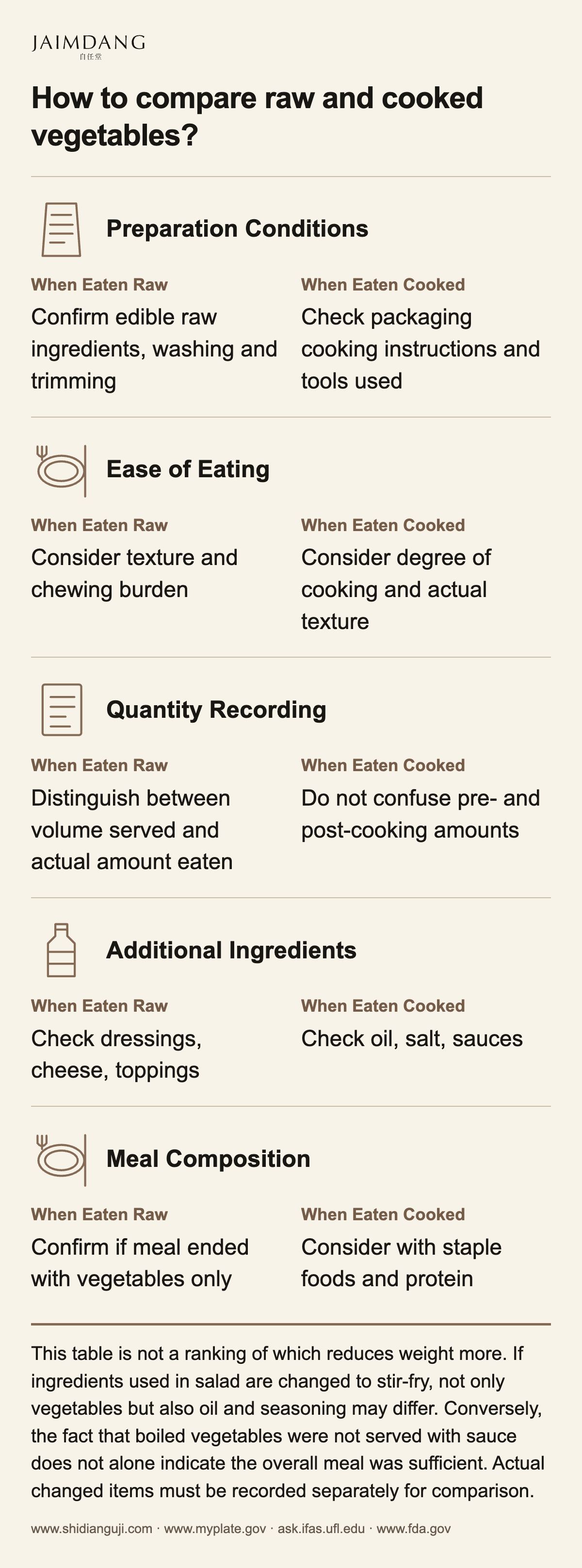
| Comparison Item | When Eaten Raw | When Eaten Cooked |
|---|---|---|
| Preparation Conditions | Confirm edible raw ingredients, washing and trimming | Check packaging cooking instructions and tools used |
| Ease of Eating | Consider texture and chewing burden | Consider degree of cooking and actual texture |
| Quantity Recording | Distinguish between volume served and actual amount eaten | Do not confuse pre- and post-cooking amounts |
| Additional Ingredients | Check dressings, cheese, toppings | Check oil, salt, sauces |
| Meal Composition | Confirm if meal ended with vegetables only | Consider with staple foods and protein |
This table is not a ranking of which reduces weight more. If ingredients used in salad are changed to stir-fry, not only vegetables but also oil and seasoning may differ. Conversely, the fact that boiled vegetables were not served with sauce does not alone indicate the overall meal was sufficient. Actual changed items must be recorded separately for comparison.
If cooked vegetables are more convenient, you may choose that form. However, the fact that food is warm is not used as evidence that metabolism has improved. Preference for avoiding cold sensations, traditional ingredient classification, and actual digestive symptoms are different information. You can explore this distinction further in Food Nature and Actual Temperature.
What is the procedure to apply to today’s meal?
First, write down one reason why eating vegetables was difficult. Whether due to taste or texture, lack of time to wash and cut, or insufficient cooking tools, the alternatives differ. Even if vegetables are in the refrigerator, find the conditions that prevent actual meal consumption. Do not automatically consider your preferences as problems to be fixed.
Second, decide on currently possible menus. Choose a method suitable for meal preparation among steaming, stir-frying, soup, or salad, but do not assume all compositions are the same just because vegetables are included. If eating as soup, distinguish and record solids and broth; if stir-fried, note added oil. Also confirm whether a new menu was added or an existing side dish was replaced.
Third, prepare safely. The FDA advises washing hands with soap and water for at least 20 seconds before and after handling fresh produce, and washing produce under running water. This does not mean washing vegetables themselves with soap or detergent. Keep raw vegetables separate from cutting boards and knives used for raw meat, and check packaging labels to see if they are ready to eat. Do not treat frozen vegetables that require cooking as ready-to-eat salad; follow their cooking instructions.
Fourth, when comparing two cooking methods for the same vegetable, check if multiple conditions changed together. If one is a small side dish and the other a large plate, the comparison is not only between raw and cooked. There is no need to force eating uncomfortable foods repeatedly to test causes. Foods suspected of allergy or restricted by medical professionals are not general comparison targets.
Fifth, keep facts that will help with your next grocery shop. Writing “I felt bloated after hastily eating a large salad at lunch” is more specific than “vegetables are bad for me.” Do not conclude superiority of cooking methods based on a single mild sensation. Repeated symptoms should be examined with quantity, eating speed, and other foods, and shown during consultation if needed. See Discomfort After Increasing Dietary Fiber for a separate question.
FAQ: Frequently Asked Questions
Does cooling cooked vegetables make them raw vegetables?
No. Whether food is cooked and the temperature when eaten are different factors. Cooked then cooled food has a cooking history and must be stored accordingly. Cooking methods are not classified by temperature alone.
If I dislike salad, can I skip eating vegetables?
You can find other cooking forms besides salad. Look for methods you find easy to eat in cooked side dishes or other menus. If there are therapeutic restrictions, follow personal guidelines rather than general recommendations.
Does eating warm food promote better weight loss even with the same amount?
Weight loss effects cannot be judged by eating temperature alone. This article is a selection tool distinguishing cooking, quantity, and preference, and does not promise weight changes by specific meal temperatures.
Can I just choose one type and keep eating it?
One ingredient does not represent all vegetables. Consider diverse compositions within available ingredients and cooking methods, but there is no obligation to add new vegetables to every meal.
Reference Originals
- Huangdi Neijing Suwen Buzhu Shiwen Zang Qi Fa Shi Lun: Traditional compositional perspective of traditional dietary nourishment. Distinction from modern nutritional amounts and weight loss evidence.
- University of Illinois Extension, MyPlate: Vegetables: Examples of raw and cooked vegetables and cup-based food group servings.
- University of Florida IFAS, Cooked Produce: Relationship between cooking, nutrition, and volume.
- FDA, Selecting and Serving Produce Safely: Handwashing, produce washing, cross-contamination prevention. All checked 2026-10-27.
Jaimdang product information is product guidance and does not provide evidence for the effects of vegetable cooking methods.
jaimdang Korean Herbal Care
Online consultation and prescriptions tailored to your constitution.
View products