
Low-Sodium Salt: When Should You Check Potassium?
If you choose low-sodium salt to practice the traditional Korean food-care perspective (sikchi) of ‘harmonizing flavors,’ you must first check what ingredient was used to reduce sodium. Salt substitutes containing potassium chloride are not equally suitable for every family member. Examine the product’s ingredients along with the eater’s kidney function, medications, and dietary guidelines separately. The label “low sodium” does not mean you can use more of it.
Contents
How Are the Harmony of Five Flavors and the Definition of Low-Sodium Salt Different?
The final part of the seasoning section in Sikmulboncho (食物本草, Food Materia Medica) describes balancing different flavors and cautions against excessive consumption. When bringing this sikchi perspective to today’s table, the question is less about which flavor to add more of and more about which seasonings overlap. The traditional organ concept shin (腎) is not equivalent to modern measurements of kidney function or potassium excretion.
The low-sodium salt substitutes discussed here are products that replace part of the sodium in regular salt with potassium or other elements. Since sodium and potassium are different substances, reading only that sodium is reduced and omitting the rest of the ingredients makes proper product comparison difficult. Not all low-sodium labeled products have the same composition. Distinguish them based on the actual ingredient names and nutrition information on the packaging.
The harmony of five flavors cannot be replaced by a prescription to add more potassium salt. Traditional literature is not data verifying the mixing ratios or target users of modern products. This article guides dividing what can be adjusted at the table and what must be checked first due to individual health conditions, rather than recommending unconditional seasoning changes. The perspective of maintaining the overall meal composition while checking seasonings can be applied, but it does not ignore medical contraindications.
What Do the Figures 2g and 5g Mean?
The WHO adult recommendation of less than 2g sodium per day corresponds to less than about 5g of salt. This is a standard for monitoring sodium in all food and seasonings, not a permissible amount to add separately as new salt. Sodium and salt are not names for the same substance and should not be read as the same number. If there are individual restrictions or therapeutic diet guidelines, those take precedence.
The WHO’s 2025 conditional recommendation for potassium-containing low-sodium salt targets the general adult population. Pregnant women and children are excluded, as are those with impaired kidney function or conditions affecting potassium excretion. Examples include those using potassium-sparing diuretics or potassium supplements. This distinction is not a risk diagnosis table for specific families but a reason to confirm applicable users before communal cooking.
When comparing products, align the numerical bases. If one product shows values per 100g and another per small serving size, do not compare numbers by size alone. Low-sodium salts may still contain sodium, so adding much more than before makes it difficult to know how the originally intended sodium reduction changes. Do not arbitrarily calculate sodium or potassium values for products with unknown mixing ratios.
How Can You Compare Different Ways to Reduce Salt?
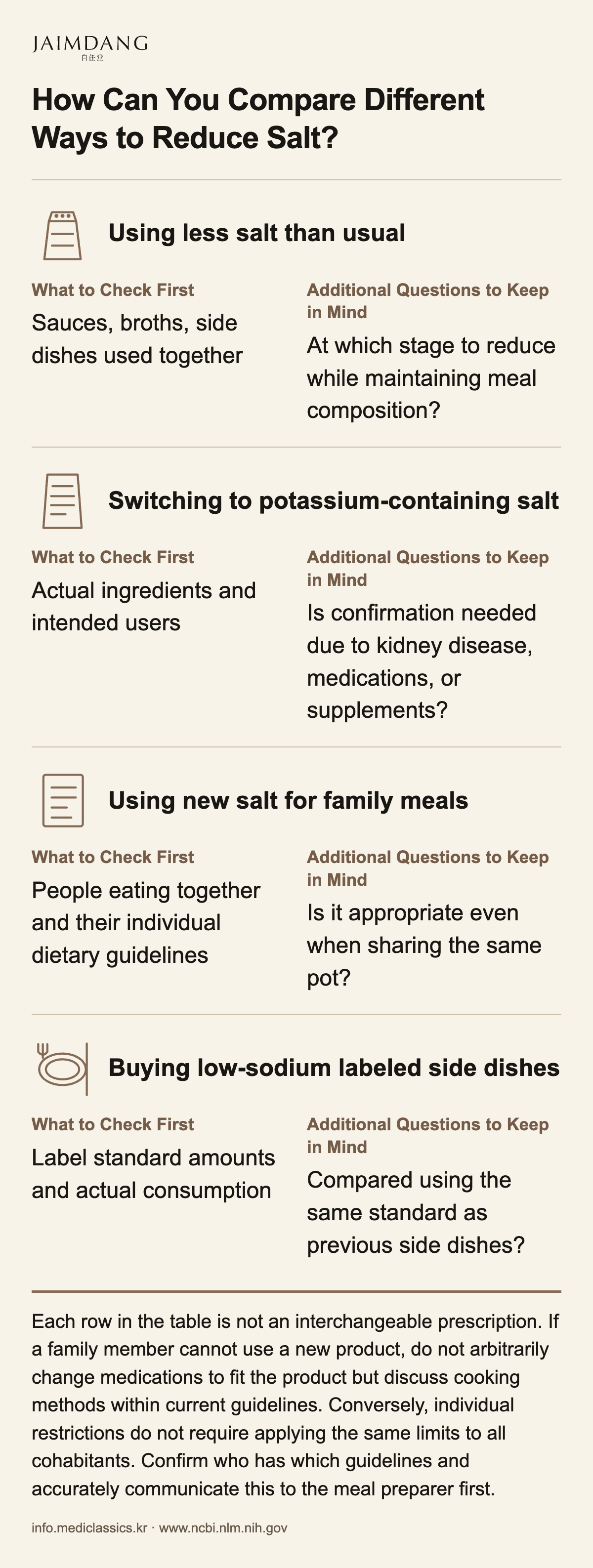
| Change Intended at the Table | What to Check First | Additional Questions to Keep in Mind |
|---|---|---|
| Using less salt than usual | Sauces, broths, side dishes used together | At which stage to reduce while maintaining meal composition? |
| Switching to potassium-containing salt | Actual ingredients and intended users | Is confirmation needed due to kidney disease, medications, or supplements? |
| Using new salt for family meals | People eating together and their individual dietary guidelines | Is it appropriate even when sharing the same pot? |
| Buying low-sodium labeled side dishes | Label standard amounts and actual consumption | Compared using the same standard as previous side dishes? |
Each row in the table is not an interchangeable prescription. If a family member cannot use a new product, do not arbitrarily change medications to fit the product but discuss cooking methods within current guidelines. Conversely, individual restrictions do not require applying the same limits to all cohabitants. Confirm who has which guidelines and accurately communicate this to the meal preparer first.
When seasonings overlap in soups, side dishes, and sauces, simply changing the salt container does not automatically change the entire meal. For example, if new salt is used in soup but salty side dishes and dipping sauces remain unchanged, record the actual composition together. Check specific cooking steps such as whether sauces can be separated or if seasonings are habitually added before tasting. This case is not a calculation predicting weight or blood pressure outcomes.
What Should You Check Before Cooking for the Family?
The first step is to distinguish the products. Take photos of the exact product name, ingredients, nutrition labels, and usage/storage instructions. Nicknames like “good salt” or “healthy salt” make it difficult to verify ingredients. Even if transferred to another container, keep the original label and do not mix new and old products to obscure their source.
The next step is to identify who eats together. If someone has dietary guidelines due to kidney disease, uses potassium-related medications or supplements, or if pregnant women or children eat together, check with healthcare providers whether the same application is possible. Knowing there is no specific illness is different from having a current health assessment. This article alone cannot determine usability or replace examinations.
When confirming, ask “Can this product be used in this food and eaten by family members taking these medications?” rather than “Is low-sodium salt good?” If medication names are forgotten, prepare prescriptions or actual packaging information. Do not stop prescribed medications just because the word potassium appears; maintain existing medications and dietary guidelines and discuss changes. Medication doses should not be self-adjusted based on food choices.
Next, separate and record the food to be cooked and the actual amount used. The amount added to the whole pot, the portion taken, and leftover broth differ. If potassium or sodium in shared food cannot be precisely divided, mark unknown parts. It is better to report products and cooking situations than to treat uncertain numbers as precise daily intake.
Finally, decide which choices to maintain at the next grocery shopping. Do not set success only by using new products; find feasible actions such as reducing separate sauces or adjusting combinations of salty side dishes. Avoid blaming family members or excessively restricting total food intake. If individual restrictions narrow possible choices, focus counseling on those conditions and do not apply generic online diet charts as is.
Frequently Asked Questions
Can I use twice as much if it is low-sodium salt?
No, do not interpret it that way. Check the sodium content per product and the actual amount used together. “Low sodium” is not an unlimited use label, and products containing potassium require separate confirmation of target users.
If it tastes less salty, does it also have less potassium?
You cannot judge ingredient amounts by taste. Check actual product labels and manufacturer information if needed. Do not combine salty taste perception, sodium content, and potassium content into a single value.
Should I try potassium salt first because of swelling?
Do not attribute swelling to salt alone. Repeated or suddenly worsened swelling requires evaluation of its pattern. Do not arbitrarily increase potassium intake to reduce swelling without checking kidney function and medications.
Sources
- Korea Institute of Oriental Medicine, Korean Translation of Sikmulboncho (食物本草, Food Materia Medica): Pages 232–233 on seasoning harmony and moderation. Not clinical evidence for modern kidney function or salt substitutes.
- WHO, Recommendations and Scope of Low-Sodium Salt Substitutes Guidelines: 2025 conditional recommendations, exclusions, and context of overall sodium reduction.
Further Reading
Harmony of Five Flavors and Saltiness Control explains overlapping sodium situations at the table. Jaimdang Product Information is a route to check actual product information; this article does not prove the efficacy of specific products or the safety of combined use with potassium salt.
jaimdang Korean Herbal Care
Online consultation and prescriptions tailored to your constitution.
View products