
How to Distinguish Between Hunger and Habit When You Keep Eating at Night?
There is not just one reason for eating at night. You may actually be hungry because you missed meals during the day, or the time after work to rest may be linked to eating behavior. First, examine your daytime meals, bedtime, and feelings before and after eating together. There is no need to judge a disease or conclude weak willpower from a single night eating episode. This article guides you to observe nighttime eating patterns and find points where you can make changes.
What is the difference between nighttime hunger and habit?
Hunger and the desire to eat can overlap, so there is no need to perfectly separate them yourself. Writing down when your last meal was, what and how much you ate, and whether only certain foods come to mind can help you understand the situation. This does not mean you must suppress all hunger with water or sleep. If daytime meals were insufficient, it is difficult to change your lifestyle by only prohibiting nighttime behavior.
If you take out food every time you look at your phone or turn on a video, you can also examine the environment. However, eating due to emotions does not immediately mean you have an eating disorder. If it is repeatedly difficult to control, distressing, or disrupts sleep and daily life, it is better not to reduce it to a simple habit but to seek help.
How should you record time and frequency?
For example, the context differs between a day when you ate lunch at 1 p.m. and returned home at 10 p.m., and a day when you look for a snack just one hour after dinner. These times are examples for explanation and are not criteria dividing normal and abnormal. Rather than a rule that no one should eat after a certain time, the starting point is to check your work and sleep schedule and overall intake.
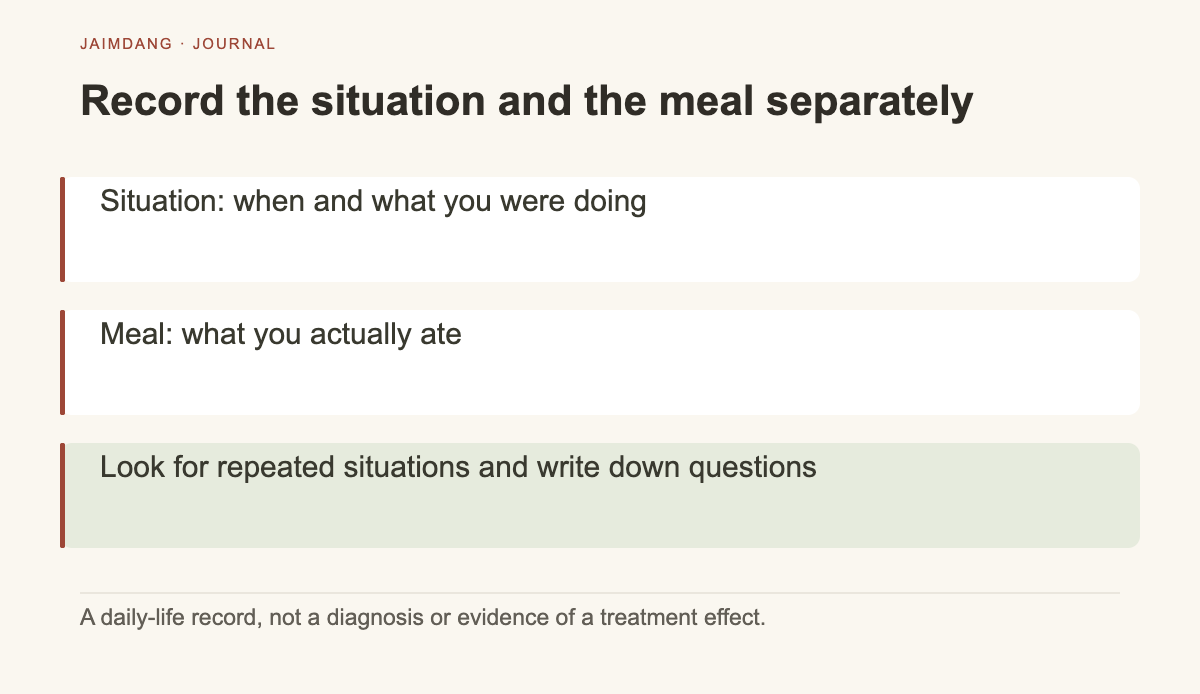
In your record, briefly note the time you ate, your last meal, feelings of hunger, your behavior at the time, and your condition the next day. If rating with numbers is burdensome, you can write in sentences. You do not need to calculate exact calories every time; the record can be used to find repetitive situations. If recording itself increases anxiety and obsession, stop and discuss other observation methods.
How to compare similar night eating situations?
| Situation | Questions to Check | Points to Try Changing |
|---|---|---|
| Hunger after late work | Did you miss meals during the day? | Prepare meals you can eat during work |
| Eating with videos | Is there a repeated stimulus other than hunger? | Separate eating place and screen-watching place |
| Stressful night | Are there other ways to calm your mind? | Find ways to rest and ask for help |
| Waking up to eat | Is your memory clear? Is sleep disturbed? | Consult a specialist about sleep and eating status |
The above is not a self-diagnosis chart. It is also necessary to distinguish and explain eating after waking from sleep and behavior with almost no memory of eating. If you have had cooking or food intake without memory, inform medical staff including the risk of injury or unsafe food. Also check medications such as sleeping pills but do not stop or change them arbitrarily.
What are the steps to start observing from tonight?
First, reflect on whether you had enough opportunities to eat during the day. Second, write down one place and situation where you eat at night. Third, decide on a small change you can make the next day. If late work is scheduled, prepare meals or instead of eating from the package, serve an amount to eat while sitting. Avoid skipping meals as a punishment the next day just because you ate a lot yesterday.
If your goal is only to endure nighttime fasting, you may miss actual discomfort. Check whether reflux or heartburn wakes you, whether anxiety is greater than hunger, and whether patterns differ on days you drink alcohol. In Korean medicine, appetite, digestion, and sleep are asked together and patterns are explained with traditional concepts such as the spleen/stomach. This alone does not prove the cause of night eating or the effect of specific prescriptions, so lifestyle records and necessary medical evaluations should be distinguished.
Frequently Asked Questions FAQ
Does night eating always turn into body fat?
You cannot determine the fate of food by the time it is eaten alone. You need to look at overall meals and lifestyle together, and this article does not mean that quantity and type do not matter even if you eat at night. Check whether you experience digestive or sleep discomfort.
If night eating is frequent, is it night eating syndrome?
You cannot diagnose based only on eating late. You must evaluate repetitive patterns, sleep, memory, discomfort, and impact on daily life together. If it is difficult to control or distressing, you can consult even if weight changes are not significant.
Will Korean herbal medicine solve the problem by only reducing appetite?
If daytime skipping meals, sleep problems, and emotional difficulties coexist, it is better not to narrow it down to appetite alone. Rather than adding medicines or supplements yourself, organize your current medications and symptoms appearing at night. Start by finding repetitive conditions instead of blaming yourself.
References
jaimdang Korean Herbal Care
Online consultation and prescriptions tailored to your constitution.
View products