
Lifestyle Habits to Prevent Yo-Yo Effect After Weight Loss

On the day I reached my target weight, I made no mark on the calendar. No one had told me what to do starting next week. For three months, the weekly decreasing number had set the direction of my day, but now, that number was supposed to stay still.
The problem begins here. During the weight loss phase, signals of success arrive weekly, but in the maintenance phase, nothing happening is success. Old habits gradually return in the absence of feedback. The maintenance phase is not an extension of the weight loss phase, but rather a different stage with different rules.
The Period After Weight Loss is Longer
Population data shows how common long-term maintenance is. A study on long-term weight maintenance in US adults published in the 『International Journal of Obesity』 in 2010 analyzed 14,306 participants from the 1999–2006 National Health and Nutrition Examination Survey (NHANES). Among adults who had been overweight or obese, 36.6% maintained a weight loss of 5% or more for over one year, and 17.3% maintained 10% or more.
There is also data collected only from groups successful in maintenance. The National Weight Control Registry (NWCR) in the United States tracks adults who have lost 13.6 kg or more and maintained it for over one year. In a 10-year follow-up analysis published in the 『American Journal of Preventive Medicine』 in 2014, the average weight loss for 2,886 registrants was 31.3 kg at registration, 23.8 kg at 5 years, and 23.1 kg at 10 years. It was estimated that over 87% maintained a weight loss of 10% or more compared to their maximum weight at both 5 and 10 years.
The same analysis also reported characteristics of those who regained weight. The extent of weight regain was greater in individuals who reduced leisure-time physical activity, loosened dietary restraint, decreased the frequency of weighing themselves, and increased their percentage of fat in caloric intake and disinhibition scores.
Commonalities in the Records of Long-Term Maintainers
Several behaviors are repeated in the NWCR data. In an analysis of breakfast consumption published in 『Obesity Research』 in 2002, 78% of 2,959 registrants reported eating breakfast 7 days a week, while 4% reported never eating it.
Physical activity data from 3,683 registrants showed an average of 2,621 kcal per week. 75% exceeded 1,000 kcal per week, with walking at 52.2% and strength training at 29.2% being the most common activities. A comprehensive review in the 『American Journal of Clinical Nutrition』 in 2005 summarized this as approximately 1 hour per day, also noting the characteristic of maintaining consistent eating patterns on weekdays and weekends.
Sitting time was also measured. In a TV viewing study published in 『Obesity』 in 2006, 62.3% of 1,422 registrants watched TV for 10 hours or less per week, and only 12.4% watched for 21 hours or more, contrasting with the average of 28 hours per week for US adults at the time. Both TV viewing time at registration and its increase over one year predicted weight regain.
However, the registry is observational data collected from self-reports of volunteers, so it does not prove a causal relationship that these behaviors led to maintenance.

Protein, Strength Training, and Sleep are Conditions for the Maintenance Phase
Protein has been addressed in trials directly targeting the maintenance phase. The DiOGenes study published in the 『New England Journal of Medicine』 in 2010 randomly assigned 773 adults from 8 European countries who had lost 8% or more of their body weight through a low-calorie diet to five different maintenance diets and observed them for 26 weeks. In the completer analysis, significant weight regain was observed only in the low-protein, high-glycemic index diet group (1.67 kg), and in the intention-to-treat analysis, the high-protein group gained 0.93 kg less than the low-protein group. The high-protein group also had a lower dropout rate (26.4% vs. 37.4%).
Strength training is involved in body composition. In a randomized study published in 『Obesity』 in 2008, 94 premenopausal women who lost approximately 12 kg were divided into aerobic, strength, and non-exercise groups for training. Only the strength group maintained fat-free mass, resting energy expenditure, and muscle strength. A review of non-pharmacological treatments for obesity in the 『대한의사협회지』 (Journal of the Korean Medical Association) in 2022, based on clinical guidelines, suggests more than 150 minutes of aerobic exercise per week, 2-4 sessions of strength training per week, and protein intake of 1.6 g or more per kg of body weight per day.
Sleep is a condition that alters the outcomes of diet and exercise. An analysis of the Nurses' Health Study published in the 『American Journal of Epidemiology』 in 2006 tracked 68,183 women for 16 years and reported that those who slept 5 hours or less per day gained 1.14 kg more than those who slept 7 hours, and the 6-hour group gained 0.71 kg more. The hormonal and metabolic adaptations of weight loss itself are summarized in [Hanbang Diet and Appetite Suppression](/en/journal/hanbang-diet-vs-appetite).
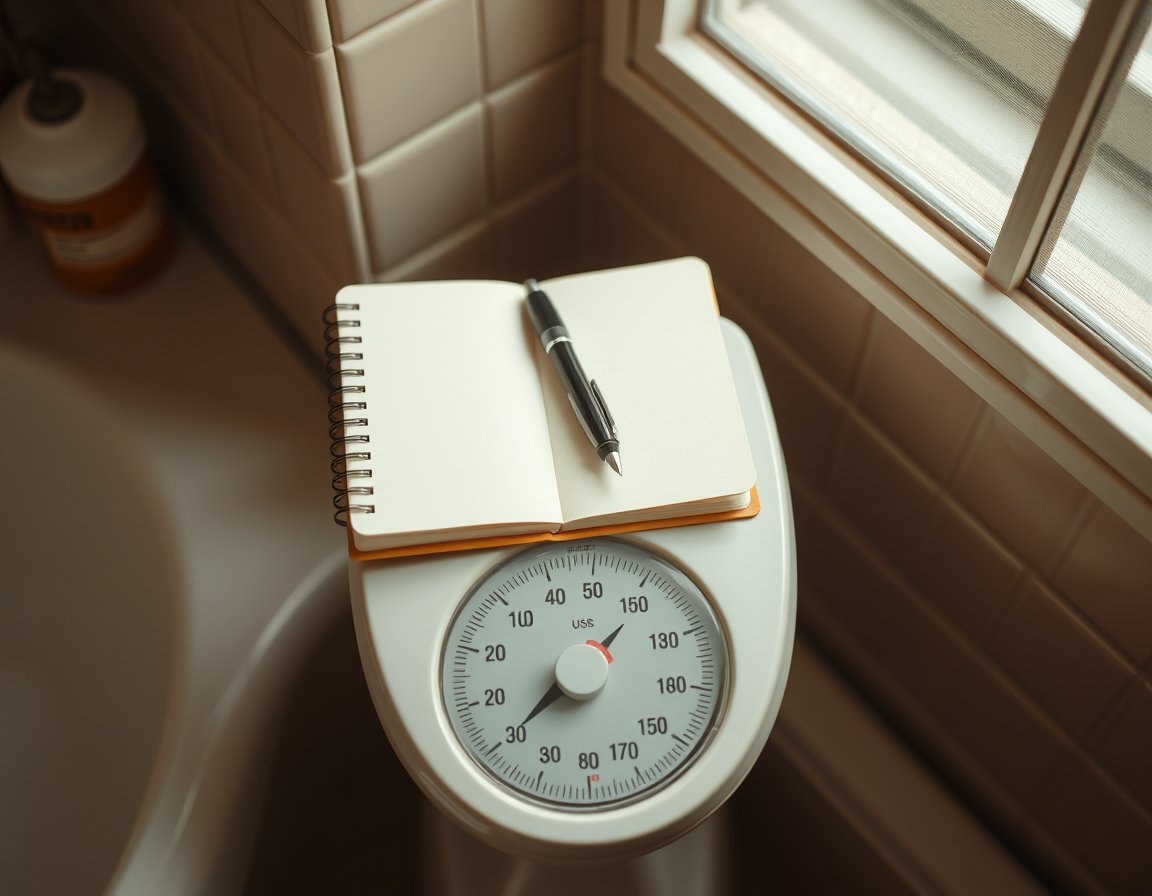
Weight Tracking is a Tool, Not a Report Card
There is data linking the act of weighing oneself to maintenance. A self-weighing study published in 『Obesity』 in 2007 tracked 3,003 NWCR registrants for one year. The one-year weight gain for those whose measurement frequency decreased was 4.0±6.3 kg, while those whose frequency increased gained 1.1±6.5 kg, and those whose frequency remained the same gained 1.8±5.3 kg.
At the same time, there is a point where this tool can change direction. The National Mental Health Information Portal's section on bulimia nervosa, supervised by the Ministry of Health and Welfare's National Center for Mental Health and the Korean Neuropsychiatric Association, describes a condition where binge eating, consuming large amounts without control within 2 hours, is repeated, along with recurrent compensatory behaviors to prevent weight gain, such as self-induced vomiting, misuse of laxatives, diuretics, or enemas, fasting, or excessive exercise. This occurs at least once a week for 3 months, accompanied by an excessive preoccupation with weight and appearance.
Such behaviors can lead to dental enamel erosion, electrolyte imbalance and hypokalemia, and menstrual irregularities or amenorrhea. The same data states that 2 out of 100 people experience bulimia nervosa in their lifetime, specifying that this is "not a problem to wait for to change with willpower alone." If any of the above items apply, it is safer to seek an evaluation first from a psychiatrist or a medical institution capable of treating eating disorders before adjusting your weight plan. If numbers start to dictate your mood for the day, that also becomes a reason to start counseling.

Korean Medicine Views the Post-Weight Loss Period from the Perspective of Deficiency Syndromes
The pathological mechanism explanation by the Korean Society of Oriental Medical Obesity Research suggests a pathway where phlegm-dampness (痰濕) arises due to weakened transportation and transformation functions from Qi deficiency (氣虛). After several months of reduced intake and increased activity, there are cases where individuals tend towards Spleen deficiency (脾虛) and Qi deficiency (氣虛) patterns, leading to easy fatigue and slow digestion. Therefore, Korean medicine assumes that the composition tailored for the weight loss phase should not be continued as is into the maintenance phase.
Thus, the indicators checked during the maintenance phase are not just weight. Digestive function, such as post-meal bloating and stool condition, sleep, such as time to fall asleep and frequency of waking at night, and for women, menstrual cycle and volume are also considered. Menstrual irregularities are both an item for diagnosing deficiency syndromes and a signal suggesting insufficient energy intake or eating problems, making them a subject for confirmation in both types of clinical practice.
JAIMDANG's Gongbihwan is also a Korean medicine prescribed by a Korean medical doctor, with its administration and continuation determined through diagnosis and prescription. It is a proprietary prescription formulated according to the monarch-minister-assistant-envoy principle. Preparation is carried out with standardized medicinal ingredients at an off-site herbal dispensary in Paju, Gyeonggi Province, undergoing HPLC quantitative analysis of marker compounds and batch-specific quality control. Detailed processes are available in [Off-site Herbal Dispensaries and Herbal Medicine Quality](/en/journal/wonoe-tangjeon-quality).
The limitations of the evidence must also be considered. The 「비만 한의표준임상진료지침」 (Standard Clinical Practice Guidelines for Obesity in Korean Medicine) published by the Korean Society of Oriental Medical Obesity Research in 2024 indicates the level of evidence for each recommendation using the GRADE methodology. Assigning grades means that recommendations with lower grades are also included, and it is not yet at a stage where individual prescriptions can be definitively stated to prevent weight regain.
Four Things to Do Starting the Week After Weight Loss
- Set a maintenance range instead of a target number — Define an upper and lower limit, and only make adjustments in weeks where the 7-day average exceeds the upper limit. Methods for standardizing measurement conditions are available in [Diet Plateau](/en/journal/diet-plateau).
- Pre-determine your weight measurement frequency — Decide whether to weigh daily or 2-3 times a week and stick to it. A gradual decrease in frequency or letting numbers dictate your mood are both warning signs.
- Incorporate protein and strength training into your maintenance routine — Include protein with every meal, and mark 2-4 strength training sessions and over 150 minutes of aerobic exercise per week on your calendar. Do not reduce your exercise volume just because weight loss has ended.
- Record sleep times and sitting times together — Log your bedtime, wake-up time, and time spent in front of screens alongside your weight. In maintenance data, these two appear as frequently as meals.
References
- Thomas JG et al., Weight-loss maintenance for 10 years in the National Weight Control Registry, *American Journal of Preventive Medicine* 46(1):17-23, 2014
- Wing RR, Phelan S, Long-term weight loss maintenance, *American Journal of Clinical Nutrition* 82(1 Suppl):222S-225S, 2005
- Butryn ML et al., Consistent self-monitoring of weight: a key component of successful weight loss maintenance, *Obesity* 15(12):3091-3096, 2007
- Larsen TM et al., Diets with high or low protein content and glycemic index for weight-loss maintenance, *New England Journal of Medicine* 363(22):2102-2113, 2010
- Ministry of Health and Welfare National Center for Mental Health · Korean Neuropsychiatric Association, National Mental Health Information Portal 「Bulimia Nervosa」
*This article is written for the purpose of conveying research and guideline information related to weight maintenance and does not guarantee the diagnosis or treatment efficacy of specific diseases, nor weight loss and maintenance results. Korean herbal medicines, including Gongbihwan, are prescribed by a Korean medical doctor, with their administration determined through diagnosis and prescription, and individual responses and progress may vary. If you experience binge eating, compensatory behaviors, or excessive preoccupation with weight, please seek an evaluation from a mental health professional.*
jaimdang Korean Herbal Care
Online consultation and prescriptions tailored to your constitution.
View products